
The first instinct in a capital raise is to build a long list. Two hundred names feels like coverage. Surely one of them will say yes.
The trouble is what a long list does in practice. Most of the names cannot invest in this company, at this size, in this structure. They decline, or they do not answer. Each of them has still seen the opportunity.
By the time the right investors hear about it, the raise may already feel widely shown. Experienced investors notice that, and it shapes how they respond.
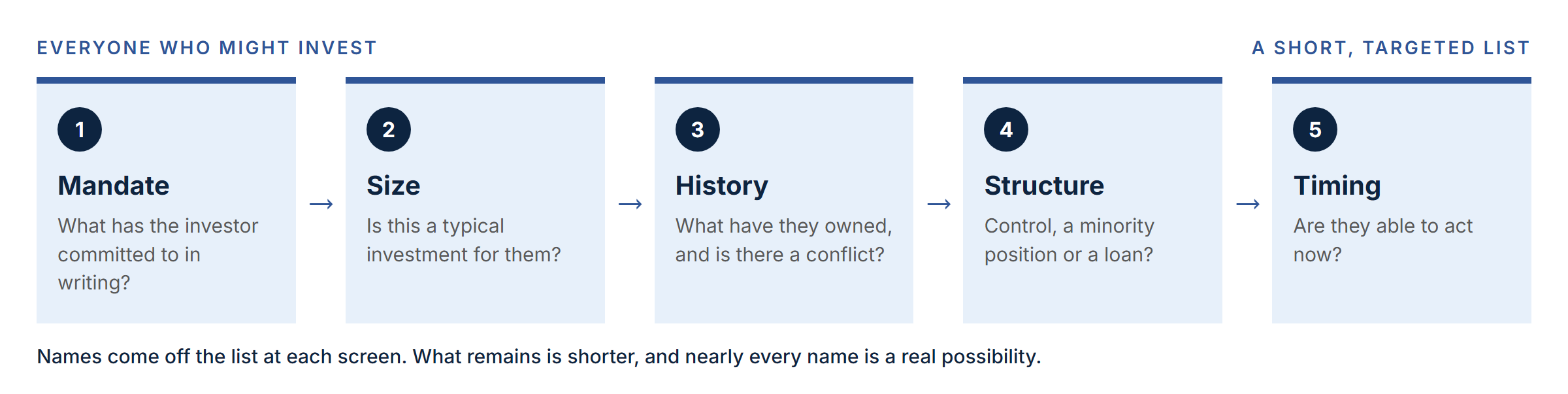
A targeted list works the other way. It starts with everyone who might invest and removes those who cannot or will not. What remains is shorter, and nearly every name on it is a real possibility.
Start with what the investor has put in writing
Most institutional investors describe what they do: the sectors, the stage of company, the geography and the type of security. It appears on their websites, in their public filings and in the record of what they have bought.
A mandate is not a preference. It is a limit the manager has agreed with the fund’s own investors. A manager who admires a company still cannot invest outside it.
The first screen is simply reading. It removes more names than any other step, and it costs nothing but time.
Check the size at both ends
Every investor has a range. Below it, the position is too small to justify the work. Above it, the investment would be too large a share of the fund.
The useful number is the typical investment, not the largest one on record. A raise that sits at the very bottom of a fund’s range competes for attention with larger opportunities, and often loses.
A company seeking a modest amount is usually better served by a smaller fund for whom the investment matters.
Look at what they have done, not only what they say
An investor’s past and present holdings show where its experience lies. One that has invested in the sector before will understand the business quickly and ask informed questions.
The same review shows conflicts. An investor that already owns a competitor may be interested for the wrong reason, and sending it detailed materials carries a risk.
So the review of holdings does two jobs. It finds the investors with relevant experience, and it flags the ones who should not receive the information at all.
A list is judged by who is left off it as much as by who is on it.
Match the structure before the meeting
Some investors buy control. Some take minority positions. Some lend, and some invest only in preferred securities. Few do all of these.
A company seeking minority growth capital is not a candidate for a fund that only buys majority stakes, however much the fund likes the business. The reverse is also true.
Settling what the company is offering comes first. Then the list is screened against it, and the mismatches come off before anyone’s time is spent.
Ask where the investor is in its own cycle
Timing is the hardest screen, because it is rarely published. A fund late in its investment period may have little capital left for new positions. A family office may have just made a large commitment elsewhere. A strategic may be absorbing an acquisition.
Much of this is learned in conversation, not research. It is one reason existing relationships matter in capital placement: they tell you who is able to act now.
Why the short list tends to do better
A list screened on these five points is usually a fraction of the original. That is the intent, and it helps in four ways:
- Confidentiality holds. Fewer parties know the company is raising capital.
- Each approach can be specific. A note that explains why this investor suits this company is read differently from a mass mailing.
- Feedback is usable. When a well-matched investor declines, the reason says something about the opportunity. When a poorly matched one declines, it says nothing.
- Interest arrives together. Several qualified investors engaged at the same time give the company a choice of terms.
When a well-matched investor declines, the reason is information.
A short list is not a small ambition. It can be widened in stages if the first group does not produce a result. A list that began too wide cannot be narrowed afterward.
Your next step
Take the investor list you have, or the one you would build, and run it through the five screens: mandate, size, history, structure and timing. Mark each name yes, no or unknown. The unknowns are the research to finish before any outreach.
The next piece in this series looks at strategic investors, and at what a strategic is buying besides equity.
This article is general information. It is not investment, legal or tax advice, and it is not an offer to buy or sell any security.
Securities are offered through GT Securities, Inc. | Member FINRA, SIPC