
Owners often begin a raise by asking who might invest. A better first question is what the company is offering.
Capital comes in forms. A loan, a preferred share and a common share each ask for something different in return. Some cost cash every month. Some cost ownership. Some cost control, but only if things go wrong.
The form also decides who is worth calling, because most investors provide only one or two of them.
Choosing the instrument first makes the investor list shorter and better.
Senior debt: the least expensive, with conditions
Senior debt is borrowed money, repaid with interest and usually secured by the company’s assets or cash flow. The lender does not share in the company’s growth, so this is the least expensive capital.
The cost is not only the interest. A senior loan comes with covenants, reporting duties, limits on distributions and acquisitions, and a fixed repayment schedule.
It suits a company with steady cash flow. It fits poorly where earnings vary from year to year, or where the cash is needed for growth.
Mezzanine and subordinated debt: more room, at a higher price
This debt ranks behind the senior lender and is paid after it. Because it carries more risk, it costs more. Part of the return may accrue instead of being paid in cash, and some lenders ask for a small share of the equity.
In exchange, the terms usually give the company more room than a senior loan does.
It is most often used to fill a gap: the difference between what a senior lender will provide and what the owners would otherwise have to raise by selling shares.
Preferred equity: ownership with priority
Preferred shares are ownership, with rights that rank ahead of the common shares. The holder is typically entitled to a set return and to be paid first in a sale. Many preferred shares can convert into common.
Preferred investors usually ask for a board seat and for approval rights over major decisions. Some ask for the right to be bought out after a period of years.
There is usually no monthly payment, which protects cash. The terms deserve close reading all the same, especially the ones that apply if the company falls short of its plan.
Common equity: no repayment, a permanent partner
Common equity has no required payments and no maturity. The investor shares in whatever the company becomes, and in the decisions along the way.
It is the most forgiving capital when a company struggles. It is the most expensive when a company succeeds, because a share of that success has been given away for good.
Debt is rented. Equity is sold.
Cost against control
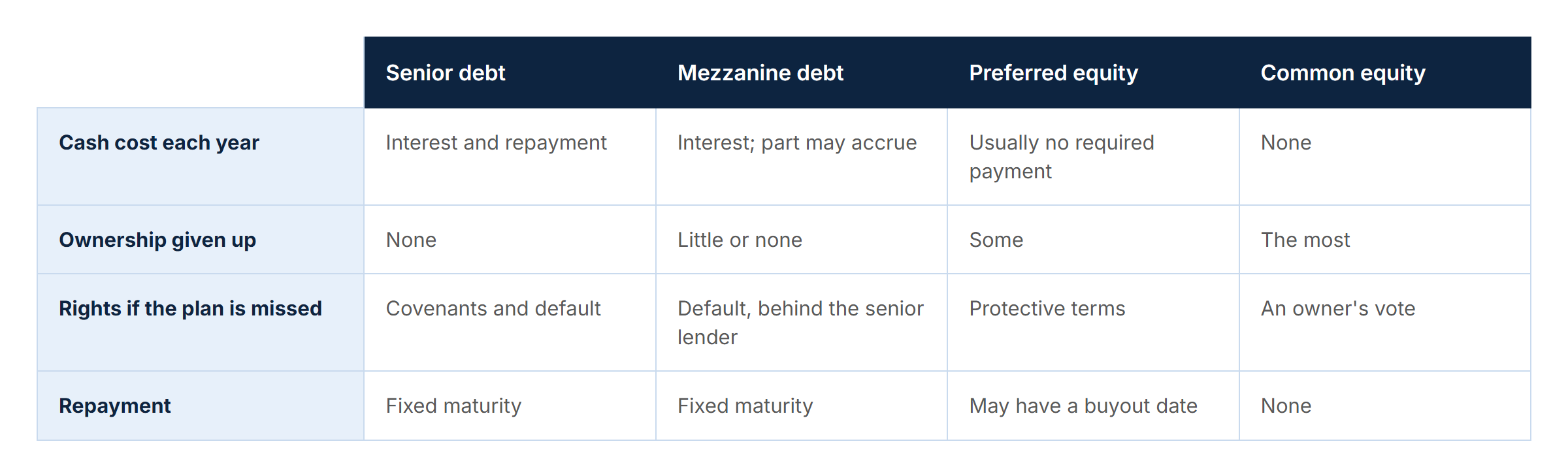
Four questions put the instruments side by side:
- What does it cost in cash each year? Debt requires interest and repayment. Equity requires nothing.
- What does it cost in ownership? Senior debt costs none. Mezzanine debt may cost a little. Equity costs the most.
- Who gains rights if the plan is missed? Lenders gain them through covenants and default. Preferred holders gain them through their protective terms.
- When must it be repaid? Debt has a maturity. Preferred equity may have a buyout date. Common equity has neither.
No instrument wins on all four. Each trades one cost for another.
Matching the instrument to the use
The use of the money usually points to the form.
Equipment or a building with a long life and a predictable return can support debt. An acquisition with established cash flow can often support a mix. Unproven growth, such as a new market or a new product, generally calls for equity, because a repayment schedule does not wait for the results.
Many raises combine two or more instruments. The combination is the capital structure, and it is worth designing on purpose.
The instrument decides which investors are worth calling.
Your next step
Write down three things: what the money will be used for, how much cash the company could commit to payments each year after a poor year, and how much ownership and control the owners are prepared to share. Together they point to the instrument, and the instrument points to the investors.
The next piece in this series covers the documents investors read first, and what each one has to do.
This article is general information. It is not investment, legal or tax advice, and it is not an offer to buy or sell any security.
Securities are offered through GT Securities, Inc. | Member FINRA, SIPC