
Owners who have not raised outside capital before usually ask how long it takes.
The honest answer is that it depends on where the company stands when it starts. Much of the work in a placement is done before the first investor is called.
A placement moves through stages in order. Each has work that cannot be skipped, and things the company should have ready before it begins.
Knowing the stages does not make the process short. It prevents the delays that come from starting a stage unprepared.
Stage one: preparation
Before any outreach, the company settles what it is seeking: the amount, the use of the money, the instrument and how much control it will share.
Then the materials are drafted, the investor list is built and screened, and a data room is started.
Have ready: three years of financial statements, current-year results and a clear record of who owns the company. This stage is the one most within the company’s control, and time spent here is recovered later.
Stage two: the first approach
The teaser goes to the targeted list. Interested investors sign a confidentiality agreement and receive more.
The purpose is narrow: to find out which investors are interested enough to study the company. A quick no is useful. It frees attention for the others.
Have ready: a confidentiality agreement in a reasonable form, and one person who answers first questions promptly and the same way each time.
Stage three: review and first meetings
Investors read the full memorandum and the model, send questions and meet management.
They are forming two judgments. One is about the business. The other is about the people running it, and whether what they say holds together.
Have ready: a management presentation, and considered answers to the hard questions that can be predicted, such as a weak year, a large customer or a new competitor.
In a first meeting, investors are judging two things: the business and the people running it.
Stage four: indications of interest
Investors who remain interested put their thinking in writing. An indication of interest is not binding. It sets out a value or a range, the structure proposed, the main conditions and the diligence still needed.
This is the point at which the company can compare investors and decide which to take further.
Have ready: one way of comparing the indications on the same basis. Price is one line. Structure, control terms, certainty and timing are the others.
Stage five: deeper diligence and the term sheet
The selected investors receive access to the data room. Site visits and detailed sessions follow.
A term sheet comes next. It summarizes the principal terms: the amount, the price or rate, the type of security, the governance rights and the conditions to closing. Most of it is usually not binding, apart from confidentiality and any period of exclusivity.
Having more than one investor at this stage is what gives a company a choice of terms.
Have ready: an organized data room, legal counsel engaged before the term sheet arrives, and a clear view of which terms matter most to the owners.
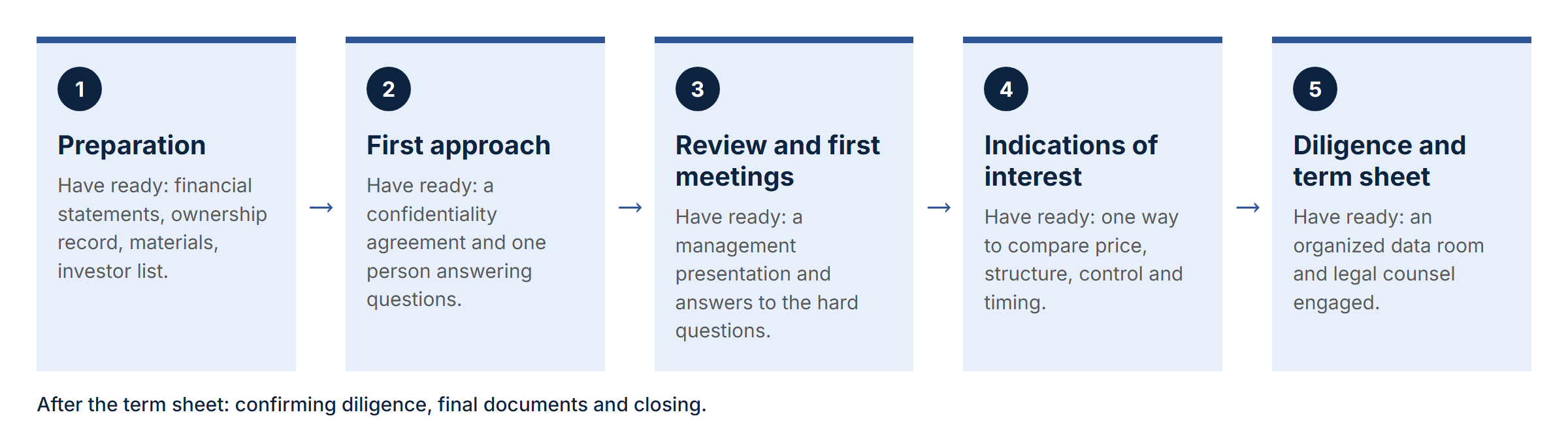
After the term sheet
A signed term sheet is not a closing. Confirming diligence, final documents and closing conditions remain.
Terms can still change if diligence turns up something that was not disclosed. That is the practical reason for accuracy in the earlier stages.
What sets the pace
Five things decide how long a placement takes:
- The state of the financial information when the work begins.
- How quickly the company answers questions and requests.
- How many qualified investors are engaged at the same time.
- Each investor’s own process, including when its committee meets.
- Management’s time. The business still has to be run while capital is raised.
The company controls the first two fully, and the third in part.
Much of the work in a placement is done before the first investor is called.
Your next step
Mark the stage the company has reached today. Then list the “have ready” items for that stage and the next, and note which are missing. That list is the work plan.
The final piece in this series covers what to do when a raise stalls.
This article is general information. It is not investment, legal or tax advice, and it is not an offer to buy or sell any security.
Securities are offered through GT Securities, Inc. | Member FINRA, SIPC