
Some of the largest pools of capital in the world belong to governments and to investors based abroad. For a middle-market company with the right project, they can be the best fit on the capital map.
They are also the investors whose process surprises owners most. The meetings go well. The interest is real. Then months pass.
Usually nothing is wrong. The capital is patient, and so is the process that releases it.
A company that plans for that pace can work with these investors. One that needs to close quickly usually cannot.
Who these investors are
Sovereign wealth funds invest national savings on behalf of a government. Their horizons are long, often measured in decades.
Offshore investors are a wider group: foreign companies, family groups, and pension and investment funds placing money outside their home markets.
Their reasons vary. Some want diversification. Some want access to a market, a technology or a supply source. Some invest in line with national priorities such as food, energy or infrastructure.
Why they look at the middle market
Many of these investors place most of their money through funds or in very large transactions. A direct investment in a middle-market company usually has a specific reason behind it.
The sector may matter to the investor’s home economy. The company may be a platform that can take more capital over time. There may be a partner the investor already trusts.
Size is a real consideration. Minimum investments are often large, so a company may need to show how a first investment leads to later ones.
How decisions are made
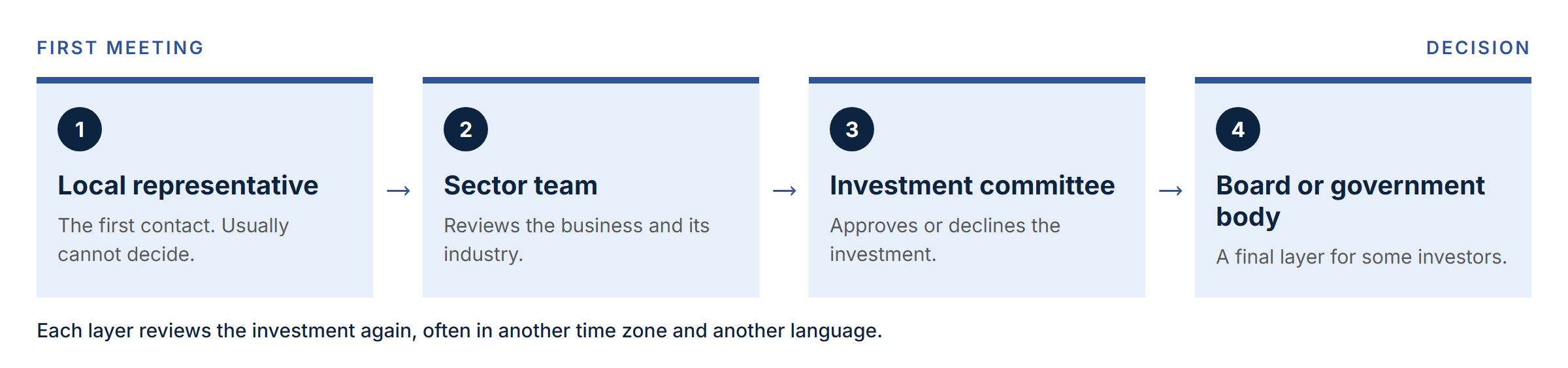
Decisions pass through layers. A local representative or regional team comes first, then a sector team, then an investment committee, and sometimes a board or a government body.
Each layer reviews the investment again, often in another time zone and another language. The people a company meets first usually cannot decide.
Intermediaries are common in this part of the market, and their standing varies. Not everyone who says they represent offshore capital does. Ask whom they represent, and confirm it with the investor directly.
Confirm who speaks for the capital before sharing anything that matters.
What diligence looks like
Expectations are high. Audited financial statements, clear ownership records and a clean compliance history are the starting point.
The checks run in both directions. The investor examines the company and its owners. The company, its bank and its lawyers need to understand the investor and the source of its funds.
Reputation weighs heavily. An investor owned by a government is careful about what its name is attached to.
What crosses the border with the money
A cross-border investment brings questions that a domestic one does not:
- Government review. Some countries review foreign investment in sensitive sectors. A review adds time and can add conditions.
- Tax and structure. The investment may come through a holding entity. Both sides need tax advice early, before the structure is fixed.
- Currency. Commitments and distributions may be in different currencies, and someone carries that risk.
- Governance. The investor may expect reporting, board practices or policies that follow its own rules.
None of these is unusual. Each takes time, and each is easier to address at the start than near the closing.
Planning the timeline
The practical answer is to treat this capital as its own track. Start those conversations earlier than the domestic ones, and avoid making the closing depend on their pace.
One approach is to complete a first round with investors who can move sooner, and leave room for the long-horizon investor in a later one. By then the relationship and the diligence are already underway.
This capital is patient. The company working with it has to be patient too.
Your next step
Decide how long the company can wait for its capital, and write the answer down. If the answer is a few months, sovereign and offshore investors belong in a later round, and the conversation with them can still begin now.
The next piece in this series covers debt, equity and what sits between them, and why the instrument is chosen before the investor.
This article is general information. It is not investment, legal or tax advice, and it is not an offer to buy or sell any security.
Securities are offered through GT Securities, Inc. | Member FINRA, SIPC