
An investor decides whether to spend time on a company long before meeting its owners. The decision is made from documents, read in a set order.
Each document has one job. The first earns a second look. The second protects what follows. The third makes the case. The fourth lets the investor test it.
Trouble starts when one document tries to do another’s job, or when two of them disagree.
The teaser: one or two pages, no name
The teaser is a short summary, usually written without the company’s name. It describes the business, its market, its size and the transaction the company is seeking.
Its only job is to let an investor decide whether to sign a confidentiality agreement and learn more.
A good teaser says enough to qualify the opportunity and not enough to identify the company. The common mistakes are length, a promotional tone and details that give the name away, such as a location combined with an unusual product.
The NDA: before anything confidential
The confidentiality agreement, or NDA, is signed before the name and the details are shared. It sets what the investor may do with the information, who else may see it and for how long the duty lasts.
Investors negotiate these agreements, and funds will decline terms that would restrict their ordinary business. A reasonable form, ready to send, avoids losing a week at this step.
Keep a record of who has signed. It becomes the list of who knows the company is raising capital.
The CIM: the full case
The confidential information memorandum, or CIM, is the main document. It covers the business, its history, products, customers, market, management, financial results and plan, and the transaction proposed.
Its job is to answer what a serious investor would ask in the first two meetings. Those meetings can then be spent on judgment instead of on gathering facts.
It has to be accurate, because every statement in it will be tested later. A claim that does not survive diligence costs more than it earned.
It should also be balanced. A weakness explained in the CIM, with context, is read very differently from one an investor finds alone.
The model: the numbers behind the case
The financial model shows the historical results, the projections and the assumptions that connect them.
Investors do not simply read a model. They change the assumptions and watch how the results respond. A model with hidden assumptions or typed-in totals loses their confidence quickly.
Projections carry more weight when each is tied to evidence: signed contracts, a backlog, a pricing history or capacity already built.
Why the documents have to agree
The four documents are read against each other. Revenue in the teaser should match the CIM. The CIM should match the model. The model should match the financial statements.
Small differences are noticed. To an investor they suggest carelessness, or a company that does not know its own numbers.
The practical answer is to build all four from one set of figures, and to have one person check them against each other before anything is sent.
Investors read the documents against each other. They should agree.
The order, and why it matters
The documents go out in stages:
- The teaser goes to a targeted list of investors.
- Those who are interested sign the NDA.
- They receive the CIM and, usually, the model.
- Management meetings follow, and then a data room for detailed diligence.
Each step narrows the group. That is the purpose of the order. Customer names, pricing and contracts are held back until the investors still involved are few and serious.
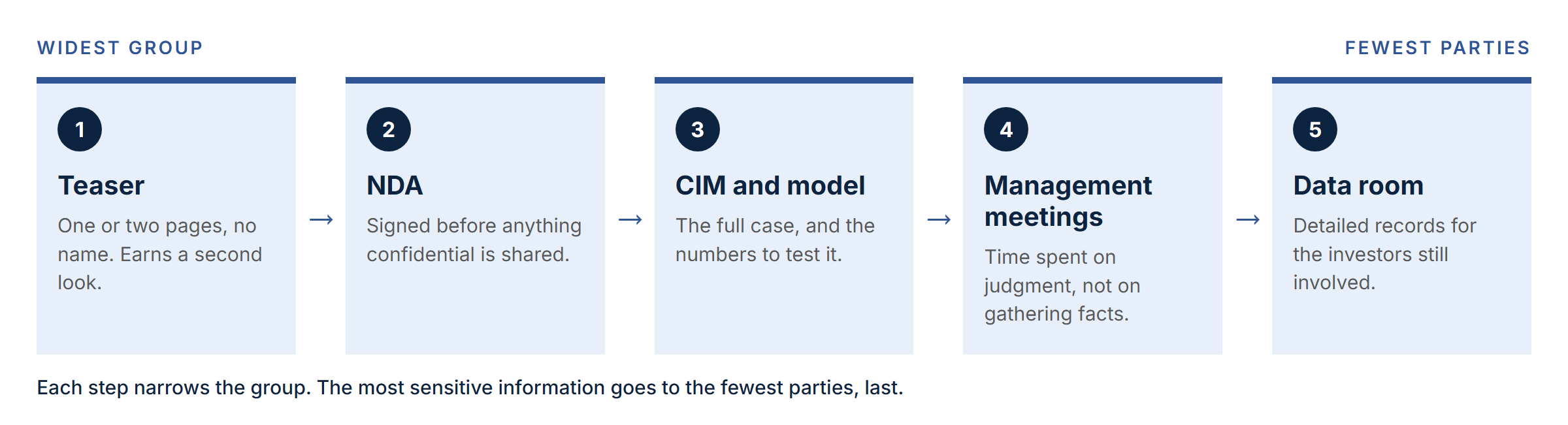
The most sensitive information goes to the fewest parties, last.
Your next step
Before any document is drafted, write down the five facts an investor will most want to verify about the company. Then find the record that proves each one. Where the proof is missing or weak, that is the first job, ahead of any writing.
The next piece in this series walks through a placement stage by stage, from the first call to the term sheet.
This article is general information. It is not investment, legal or tax advice, and it is not an offer to buy or sell any security.
Securities are offered through GT Securities, Inc. | Member FINRA, SIPC