
Most raises have a quiet period. The meetings were held and the materials were sent. Now the replies are slow, and the owner wonders whether to push harder or change something.
A stall is information. Investors rarely say plainly why they have stopped moving, but their behavior says a good deal.
Reading it correctly matters. The usual response is to send the same materials to more investors, and that tends to make things worse.
Signals that a raise has stalled
A slow week is not a stall. A pattern is:
- Investors ask for more information and then do not respond to it.
- First meetings do not lead to second meetings.
- Several investors decline, each for a different stated reason.
- Interest arrives only on terms far from those the company sought.
- The same question keeps coming back.
Different polite reasons from different investors often hide one real reason. The work is to find it.
Cause one: the list
The company may be talking to the wrong investors. Their mandate, size or preferred structure does not match the opportunity.
The sign: fast declines that mention fit.
The response: return to the screening, and build a shorter and better matched list before anyone else is approached.
Cause two: the terms
The valuation or the structure the company expects may be out of line with what investors will accept.
The sign: investors like the business, and conversations end when price is discussed. Or offers arrive in a different instrument from the one proposed.
The response: test the expectation against evidence. A different structure sometimes closes the gap, and the trade-off should be weighed honestly.
Cause three: the story or the materials
Investors may not understand the business, or the numbers may not support the description of it.
The sign: the same basic question, asked by one investor after another.
The response: answer that question in the materials, early and plainly, and check that the documents agree with each other.
Cause four: something in the business
There may be a real weakness: a dominant customer, a narrowing margin, a gap in management or an open legal matter.
The sign: investors engage seriously, then withdraw after looking closely at the same subject.
The response: presentation will not solve it. Either the weakness is addressed, or it is disclosed and the transaction is structured around it.
Cause five: timing and the market
Sometimes the cause is outside the company. A sector falls out of favor, credit tightens, or investors are occupied with their existing holdings.
The sign: “not now” from investors who are not investing in anyone in the sector.
The response: wait, or look to investors who are less affected by the same conditions.
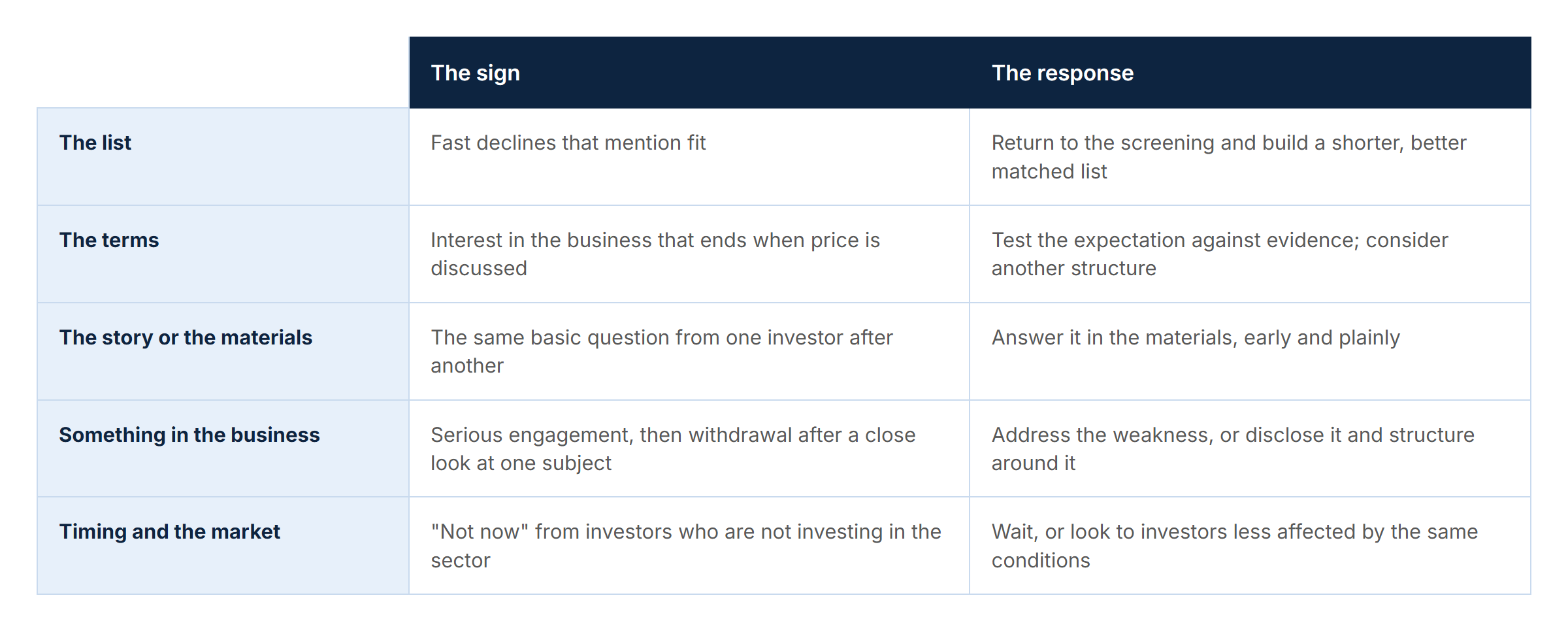
A stall is information. The question is what it is saying.
Why more outreach is seldom the answer
Widening the outreach before finding the cause sends the same problem to more investors. Each of them sees the opportunity once, and an investor who has declined rarely looks again.
A raise that has been shown widely for a long time also gathers a reputation. New investors assume that others have already passed.
When to pause
A pause is not a failure. It is the right choice when the cause lies in the business and takes time to fix, or when the next two quarters of results will make a stronger case.
Tell the investors who engaged seriously that the company will come back with updated results. That keeps the relationship open.
Then come back with something that has changed: results, a signed contract or a weakness resolved.
Return to the market with something new, not with the same materials and a later date.
Your next step
List every investor who declined or went quiet, and beside each name write the last question they asked. Look for the question that repeats. That is where the reset begins.
This piece completes the series on sourcing capital in the middle market.
This article is general information. It is not investment, legal or tax advice, and it is not an offer to buy or sell any security.
Securities are offered through GT Securities, Inc. | Member FINRA, SIPC