
A supplier to an aircraft or a defense system may hold its place for decades. Once a part is designed in and qualified, replacing the supplier is slow and costly for the customer.
That durability is what draws investors and buyers to the sector. It comes with conditions that do not apply elsewhere: long program cycles, government contracting rules and limits on who may own the company.
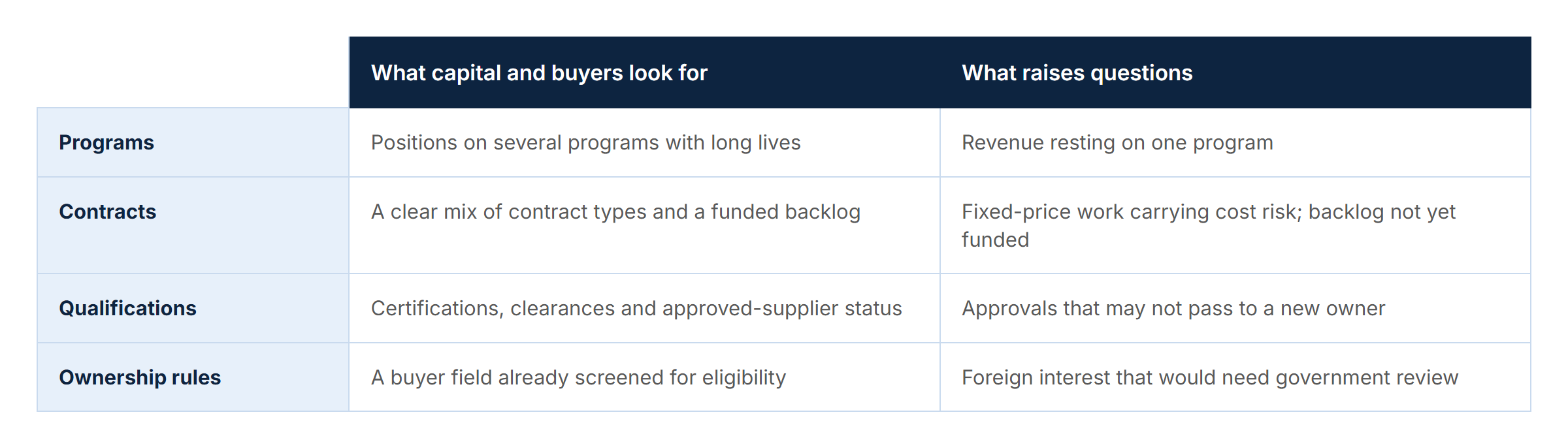
Four subjects shape nearly every transaction.
Programs
A supplier’s revenue comes from the programs it serves: a particular aircraft, engine, vehicle, satellite or system.
Buyers and investors ask which programs, where each is in its life and how the company’s content is positioned on it. A program entering production offers growth. One near its end offers less, unless aftermarket work continues.
Concentration is common and is examined closely. A company with most of its revenue on one program depends on that program’s funding and schedule, which it does not control.
Aftermarket revenue, from spares and repairs, is valued highly. It tends to be steadier and to continue long after production slows.
Contracts
How the company is paid matters as much as what it sells.
Under a fixed-price contract, the supplier carries the risk of cost overruns. Under a cost-based contract, more of that risk sits with the customer, and margins are lower and steadier.
Buyers study the mix, and they look hard at backlog. Orders that are funded count for more than orders that are expected. They also ask whether contracts can be ended at the customer’s convenience, as government contracts generally can.
Whether the company sells directly to the government or to a prime contractor affects its obligations and its leverage.
In this sector, backlog is evidence. Funded backlog is better evidence.
Qualifications and compliance
Suppliers earn their position through approvals: quality certifications, customer qualifications, and for some work, facility and personnel security clearances.
These take years to obtain and are part of the company’s value. Buyers confirm that each is current and ask what happens to it on a change of ownership.
Compliance carries weight here too. Government contractors answer to rules on accounting, pricing, export of controlled technology and the protection of sensitive information. A gap in any of them can affect the company’s eligibility for work.
Ownership rules
Who may buy a defense supplier is restricted in ways that do not apply to most companies.
Foreign investment in businesses with sensitive technology or government contracts may be subject to government review. Where a company holds security clearances, foreign ownership or influence has to be addressed before the clearances can continue.
These rules do not exclude foreign buyers in every case. They add time, conditions and uncertainty, and they should be assessed by counsel before the list of buyers is drawn up.
Who invests and who buys
Strategic buyers are central: prime contractors and larger suppliers adding capability, content or capacity. Private equity firms with sector experience are active, often building a group of related suppliers.
Lenders familiar with government contracting finance these businesses on the strength of contracts and backlog.
The field for any one company is narrower than in most sectors. The right buyer needs the eligibility to own the business, the standing with its customers and the capacity to maintain its approvals.
Preparing
Three things help. Present revenue by program, with each program’s stage and outlook. Separate funded backlog from the rest. Review compliance, including export controls and the handling of sensitive information, before a buyer does.
Customers matter in a sale as well. Some contracts require notice or consent on a change of ownership, and the timing of those conversations needs care.
The buyer acquires the company’s position on its programs. Everything in diligence tests how secure that position is.
Your next step
Build a table of the company’s revenue by program for the last three years, with each program’s customer, contract type and stage of life. Add the approvals each depends on. It answers the first questions any buyer in this sector will ask.
The next piece in this series covers technology.
This article is general information. It is not investment, legal or tax advice, and it is not an offer to buy or sell any security.
Securities are offered through GT Securities, Inc. | Member FINRA, SIPC