
Some businesses cannot be separated from their buildings. A hotel, a senior care facility, a cold storage operator, a self-storage company and a car wash are each part operating company and part real estate.
Their owners often describe them as one business. Capital sees two things: an operation that produces earnings, and property that holds value.
How the two are presented, and whether they are financed together or apart, affects how much capital is available and at what cost.
Two kinds of capital
Real estate capital and corporate capital work differently.
Real estate lenders and investors look to the property. They lend against its value and its income, accept lower returns and are comfortable with long terms.
Corporate lenders and investors look to the business. They lend against earnings, expect higher returns and pay close attention to management and growth.
A property-heavy business can draw on both. Many draw on only one, because of how the business is organized or how it has always been financed.
How lenders and investors divide it
A capital provider looking at such a business will try to separate the two parts, whether or not the owner has.
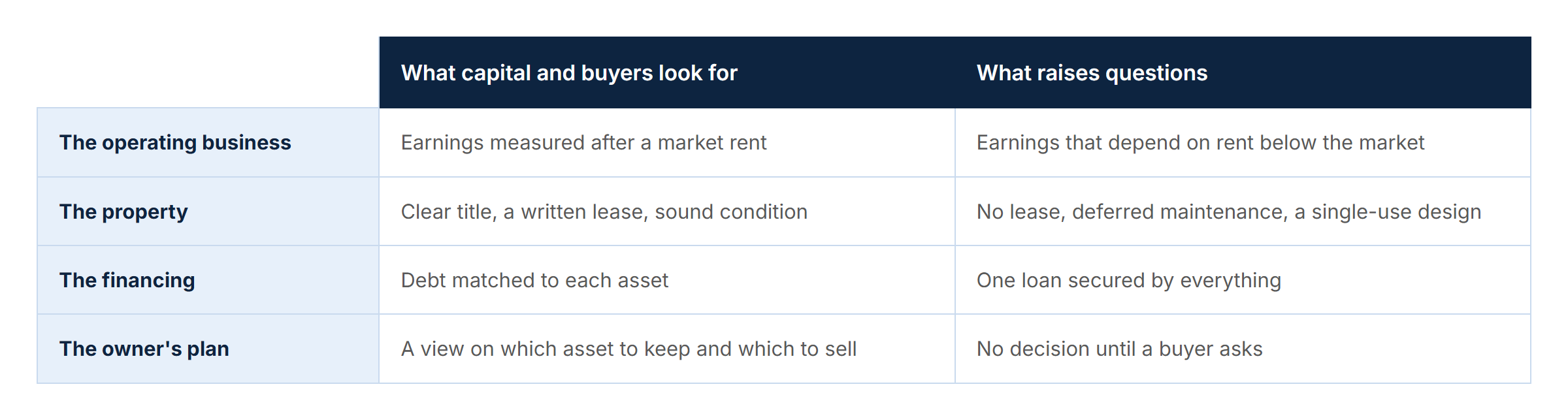
It will ask what the business earns after paying a market rent for its premises. That figure shows the value of the operation alone. It will then ask what the property is worth to an investor who would own it and lease it.
If the business earns little after a market rent, most of the value is in the property. If it earns well, the operation has value of its own.
Charge the business a market rent on paper. What it earns afterward is the value of the operation.
Structures in use
Owners have several ways to organize the two halves:
- Together. One company owns the property and runs the business, usually financed by a bank against both.
- Separated under common ownership. One entity owns the property and leases it to another that operates. Each can be financed on its own terms.
- Property sold, business retained. The property is sold to an investor and leased back, releasing capital for the operation.
- Business sold, property retained. The owner sells the operation and becomes its landlord.
Each changes who can invest, how much can be borrowed and what the owner keeps.
What makes property-heavy businesses attractive
Property gives lenders security and gives investors something that holds value if the operation weakens. That can mean more borrowing capacity and a wider field of investors than a business of the same size without property.
For buyers, it offers choices. A buyer can keep the real estate, or sell it after closing to help fund the purchase.
What raises questions
The same features can count against the business.
A building designed for one use is worth less to a property investor if the operator fails. A single loan secured by everything makes it harder to sell or refinance one part alone. Earnings that look strong only because the business pays no rent, or too little, will be adjusted downward.
Deferred maintenance is examined closely, because the property is both the security and the place of business.
Who invests and who buys
The range is wide: banks, real estate lenders, net lease investors, real estate funds, private equity firms that specialize in property-heavy sectors and operators seeking to expand.
Some want the whole. Others want only the property or only the operation. Knowing which is which shapes the approach, and sometimes points to dividing the business before going to market.
A property-heavy business has two sets of investors available to it. The structure decides whether it can reach both.
Your next step
Prepare two simple statements for the business: its earnings after a market rent, and the income the property would produce for an outside owner. Together they show where the value sits and which kind of capital to approach first.
The next piece in this series covers health and life sciences.
This article is general information. It is not investment, legal or tax advice, and it is not an offer to buy or sell any security.
Securities are offered through GT Securities, Inc. | Member FINRA, SIPC