
A power plant, a pipeline, a water system or a data facility is paid for at the beginning and earns its return over many years.
That shape defines the sector. A great deal of capital goes in before any revenue arrives, and the investors who provide it wait a long time to be repaid.
They are willing to wait. In exchange, they want to know that the revenue will be there. Most of their questions follow from that.
Revenue: contracted or exposed
The first question is how the asset is paid.
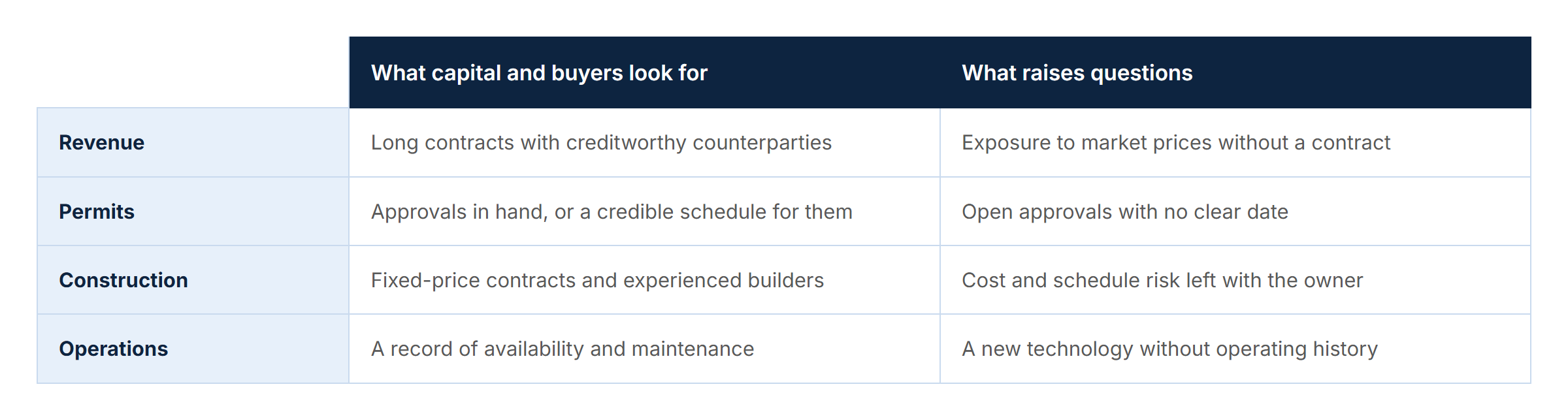
Some assets sell their output or capacity under long contracts at agreed prices. Others sell into a market at whatever price prevails. Many do some of each.
Contracted revenue supports more debt at a lower cost, because lenders can see the income that will repay them. Market exposure calls for more equity and a higher return.
The party on the other side of the contract matters as much as the contract. A long agreement is only as reliable as the customer’s ability to pay over its whole term.
Permits and approvals
Infrastructure is built with permission. A project may need land rights, environmental review, permits at several levels of government and the right to connect to a grid or network.
Each takes time, and the time is hard to predict. A project that is otherwise sound can wait years for one approval.
Capital providers distinguish sharply between a project with its approvals in hand and one still seeking them. The first is a construction project. The second is a development risk, funded by different investors at a different price.
In infrastructure, the same project is a different investment at each stage: before permits, during construction and in operation.
Construction
Building is where cost and schedule can go wrong. Providers ask who carries that risk.
A fixed-price contract with an experienced, financially sound builder places much of it with the builder. Arrangements that leave overruns with the owner call for more contingency and more equity.
They also look at the technology. Equipment with a long operating record is financed readily. A new technology, however promising, is asked to prove itself first, usually with equity.
Operations
Once built, the asset has to run. Providers look at availability, maintenance and the cost of operating over time.
For an existing asset, the operating record answers much of this. For a new one, they look at who will operate it and under what agreement.
They also consider what could change over the asset’s life: regulation, the terms on which contracts renew and the condition of the asset when the first contract ends.
Project finance
Many of these assets are financed on their own, in a separate company, with lenders repaid from the asset’s cash flow and not from the sponsor’s wider business.
That works when the risks have been placed with parties able to bear them: the builder, the operator, the customer and insurers. Lenders study each contract to see what is left with the project.
The discipline is useful even for a company that will not use project finance. Listing each risk and naming who holds it is the way investors in this sector think.
Who invests
Different capital suits each stage. Developers and specialized funds take early risk. Banks and institutional lenders finance construction and operation. Infrastructure funds, pension funds, insurers and sovereign investors buy operating assets for long, steady income.
Strategic buyers, such as utilities and energy companies, acquire assets and the businesses that build and serve them.
An owner seeking capital should know which stage the asset is in. That decides who to approach.
Patient capital waits for its return. It does not wait to learn who is carrying each risk.
Your next step
For one asset or project, list its main risks: revenue, permits, construction, technology and operation. Beside each, write who carries it today and under what document. The gaps in that list are what an investor will price.
The next piece in this series covers real estate, and businesses that own a great deal of property.
This article is general information. It is not investment, legal or tax advice, and it is not an offer to buy or sell any security.
Securities are offered through GT Securities, Inc. | Member FINRA, SIPC