
Every loan has a maturity date. On that day the balance is due in full.
Most borrowers never repay it from cash. They refinance, and the date passes without notice.
A maturity becomes a problem when the ordinary refinancing is not available. The property or the business is worth less. Earnings are lower. Lenders have tightened their terms. The loan that was made cannot be made again.
A borrower in that position still has options. They narrow as the date approaches, and the lender’s choices begin to replace the borrower’s.
Why a maturity becomes a problem
The difficulty is a gap. The loan a new lender would make today is smaller than the loan coming due.
Several things open that gap. Value may have fallen. Income may have fallen. Interest rates may have risen, so the same income supports less debt. A lender’s appetite for the sector may have changed.
The size of the gap is the central fact. Every option below is a way of closing it.
The options, in the order to explore them
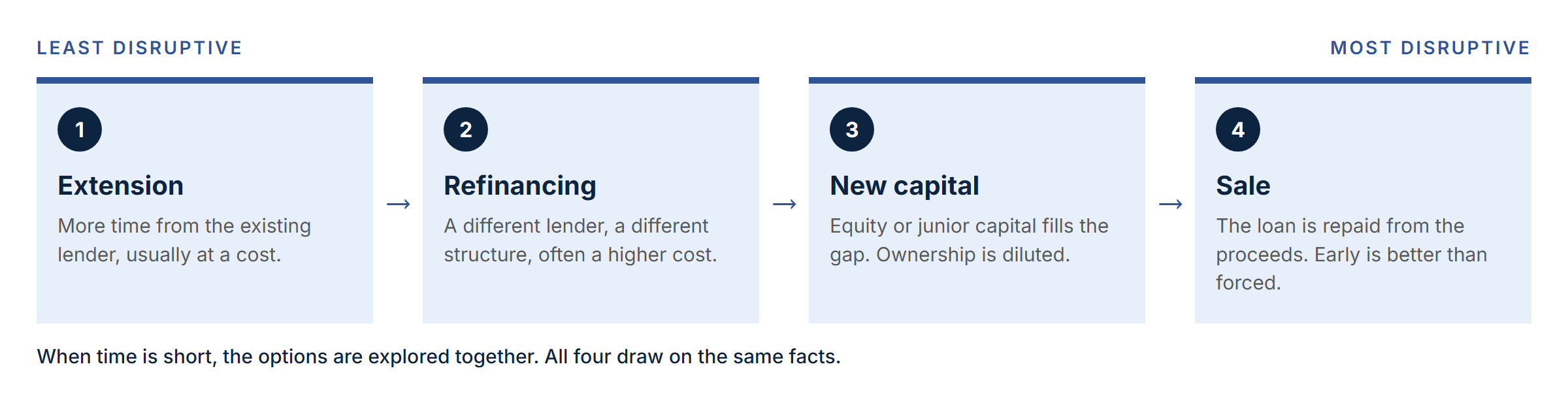
There are four, from the least disruptive to the most:
- An extension. The existing lender gives more time. This is often the simplest path, because the lender already knows the borrower. It usually has a cost: a fee, a partial repayment, a higher rate or tighter terms.
- A refinancing with another lender. A different lender may lend more, accept a different structure or take a different view of the asset, usually at a higher cost.
- New capital. The gap is filled with equity or junior capital from the existing owners or from new investors. Ownership is diluted, and a new party gains rights.
- A sale. The asset or the company is sold and the loan repaid. Done early, a sale protects whatever value the owners still hold. Done late, it is a forced sale.
When time is short, these are explored together and not one after another. All four draw on the same set of facts.
What the lender is deciding
The lender has its own choices at maturity. It can extend, sell the loan or enforce its rights.
It weighs the value of its collateral, the borrower’s plan and its own constraints. It also weighs the borrower’s conduct: whether the information has been reliable, and whether the borrower came forward.
A borrower who arrives early with facts and a proposal is treated differently from one who has gone quiet.
The lender will decide at maturity. The borrower’s options are the ones explored before then.
Start earlier than seems necessary
A refinancing or a sale takes months. Counting back from the maturity date usually shows less time than expected.
The conversation with a lender also goes better before a default than after one. A default changes the rights on both sides, and it changes the tone.
What to bring to the lender
A request for an extension is a proposal, and it should be prepared like one:
- Current financial statements and a forecast.
- An honest view of what the collateral is worth.
- An explanation of what changed.
- A specific request, and what the borrower offers in return.
- A plan and a timetable for the longer-term solution.
Lenders extend when they believe more time improves their recovery. The proposal has to show why it would.
A request for time is stronger when it comes with a plan for using it.
Your next step
For each loan, write down the maturity date, the balance that will be due and an estimate of what a new lender would lend today. Where there is a gap, begin the conversation with the current lender now, before the options narrow.
The next piece in this series covers covenant stress, and why the conversation with a lender belongs before the default.
This article is general information. It is not investment, legal or tax advice, and it is not an offer to buy or sell any security.
Securities are offered through GT Securities, Inc. | Member FINRA, SIPC