
Most financings and sales follow a familiar path. The company prepares, approaches the market and chooses among offers.
Some do not. A loan is coming due and cannot be repaid. A covenant has been missed. Partners disagree about what to do next. Time is short.
These are special situations. They are defined less by the transaction type than by the conditions surrounding it.
The conditions change what is possible. The first job is to find out by how much.
Seven conditions
Seven conditions account for most special situations:
- Liquidity pressure. Cash is not enough to meet the obligations coming due.
- Covenant stress. The company has breached a term of its loan, or is close to doing so.
- Approaching maturities. Debt comes due before it can be repaid or refinanced in the ordinary way.
- Impaired assets. An asset is worth less than the amount owed against it.
- Stakeholder complexity. Several parties must agree, and their interests differ.
- Compressed timelines. A decision is needed faster than a normal process allows.
- Cross-border constraints. Laws, currencies or approvals in more than one country limit the choices.
They seldom arrive alone. One tends to bring another.
Why the usual process does not fit
A conventional process assumes three things: time, choice and control. The company decides when to start, whom to approach and which offer to accept.
A special situation removes one or more of them. A lender has rights it can use. A date is fixed. The parties across the table know there is pressure, and they take it into account.
Approaching the market as though nothing were unusual does not work. Investors and buyers find out, and the company’s credibility suffers when they do.
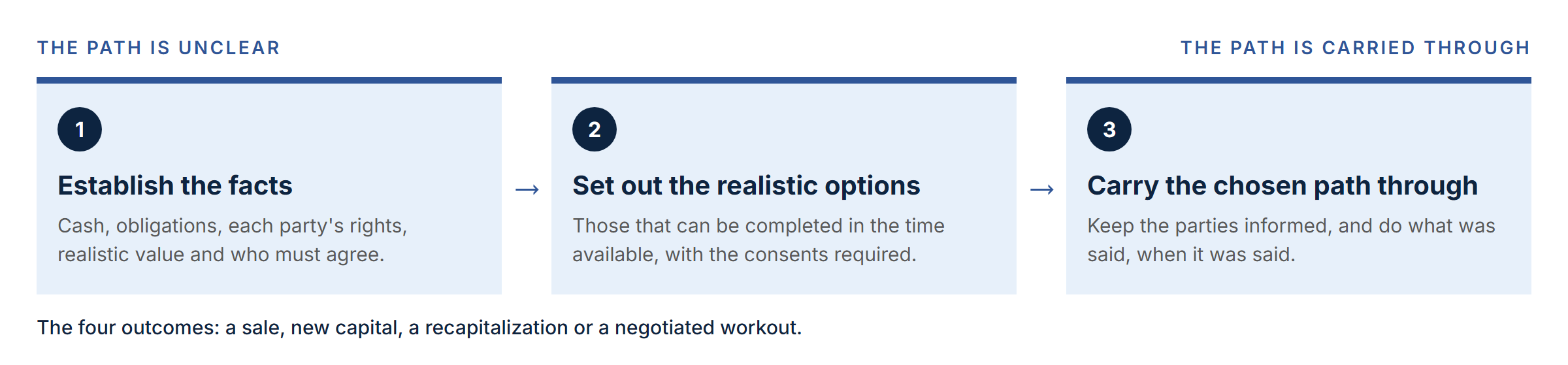
First, establish the facts
Before any option is discussed, five things need to be known:
- How much cash the company has, and how long it will last.
- What is owed, to whom, when and on what terms.
- What rights each party holds under the documents.
- What the business and its assets are worth today, judged realistically.
- Who must agree to any change.
Owners under pressure often work from hope, or from numbers that are out of date. Lenders and investors will not.
In a special situation, the first job is to establish the facts. The options come from them.
Second, set out the realistic options
Most special situations end in one of four ways: a sale, new capital, a recapitalization or a negotiated workout.
A realistic option is one that can be completed in the time available, with the consent of the parties whose consent is required.
There are usually fewer options than an owner hopes and more than an owner fears.
Third, carry the chosen path through
Carrying a plan through under pressure is its own discipline. Lenders and other parties are kept informed. The process is sized to the time available. The company does what it said it would do, when it said it would.
That last point is how credibility is kept, and credibility is what the other parties are extending.
Time is the scarce resource
Options narrow as time passes. A company that acts months before a deadline can choose among several paths. One that acts in the final weeks may have a single path, on another party’s terms.
Acting early is the most valuable step available, and it costs the least.
Early, a company can choose among several paths. Late, others choose for it.
Your next step
Write down the date on which the company’s position changes if nothing is done: a maturity, a covenant test or the week cash runs short. Count back from it. That is the time available, and it is usually less than it feels.
The next piece in this series looks at approaching maturities, and the options a borrower has before the lender decides.
This article is general information. It is not investment, legal or tax advice, and it is not an offer to buy or sell any security.
Securities are offered through GT Securities, Inc. | Member FINRA, SIPC