
Some transactions are hard because of the numbers. Others are hard because of the number of people who must agree.
A company with two lenders, three partners and a founding family does not have one decision-maker. Each party has its own interest, its own adviser and its own view of what the company is worth. Any of them may be able to stop a transaction.
In these situations, finding the buyer or the capital is often the easier part. Getting everyone to the same decision is the work.
Who the stakeholders are
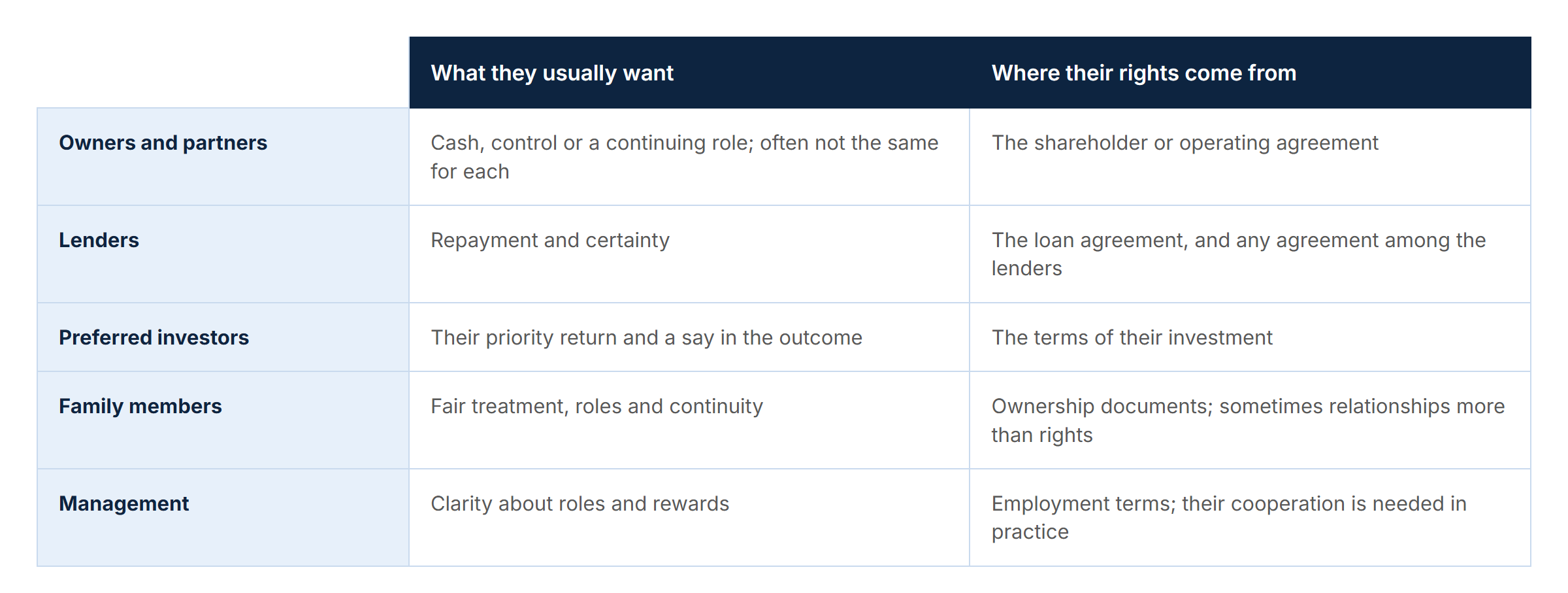
The parties differ from case to case, but five groups appear most often:
- Owners and partners. They may differ in age, wealth, need for cash and appetite for risk.
- Lenders. Senior and junior lenders hold different rights and may want different outcomes.
- Investors with preferred rights. They are usually paid first and often hold consent rights.
- Family members. In a family company, ownership and employment are bound up with relationships.
- Management. Their cooperation is needed for any outcome, and they have their own concerns.
Others can matter too: a landlord, a key customer or a licensor whose consent a transaction requires.
Map the rights before the interests
Start with the documents. Shareholder agreements, operating agreements and loan agreements say who must consent to what.
People often believe they hold rights they do not, or have forgotten rights they do. Reading the documents settles it.
The map shows whose agreement is required and whose is only desirable. Those are different conversations.
Then learn what each party needs
A stated position and an underlying interest are not the same thing. A partner who refuses to sell may want certainty about a future role or a tax bill. A lender that says it will not extend may need a partial repayment to justify the decision internally.
These things are learned in private, one party at a time. They are rarely said in a room full of people.
A position is what a party says. An interest is what would let it agree.
One set of facts
Many disagreements rest on different numbers. One owner believes the company is worth twice what another does. A lender’s view of the collateral differs from the borrower’s.
A single, credible set of facts, prepared independently where needed, removes the false disagreements. What remains are the real ones.
Sequence the agreement
Order matters. It usually makes sense to begin with the party whose consent is required and whose position sets the limits for the others. Often that is the senior lender.
The owners then settle matters among themselves, within those limits. The remaining parties follow.
Each agreement makes the next one easier. Gathering everyone in one room before positions are understood tends to harden them.
A process the parties trust
Parties in conflict discount proposals that come from each other. A proposal carried by an adviser acting for the company, and not for one faction, gets a fairer hearing.
The process has to be even-handed in practice. Every party receives the same information, and each agreement is put in writing as it is reached.
When agreement is not possible
Sometimes one party will not agree. The documents may provide an answer, such as a right for a majority to require a sale or a mechanism for one owner to buy out another.
Beyond the documents lie lenders’ remedies and the courts, which are slow, costly and public. Knowing each party’s alternative to an agreement is part of negotiating one.
Finding the buyer is often the easier part. Getting everyone to the same decision is the work.
Your next step
List every party whose consent the company would need for a sale or a financing. Beside each name, write three things: where the right comes from, what the party has said and what it may need in order to agree.
The next piece in this series covers compressed timelines, and what can and cannot be shortened.
This article is general information. It is not investment, legal or tax advice, and it is not an offer to buy or sell any security.
Securities are offered through GT Securities, Inc. | Member FINRA, SIPC