
A loan agreement asks for more than payments. It contains covenants: promises about how the company will perform and behave. Debt stays below a limit. Earnings cover interest by a set margin. Statements arrive on time.
A company can be current on every payment and still be in default because a covenant was missed.
That is covenant stress. How it is handled in the weeks before the test date often matters more than the miss itself.
What covenants are for
Covenants are a lender’s early warning. They give the lender the right to act before payments are missed, while there is still value to protect.
Some are financial and are tested at set dates. Others restrict what the company may do, such as borrowing more, paying distributions or selling assets.
A breach is a default. It gives the lender rights it did not have the day before. Lenders seldom reach for the harshest of them first, but the balance between the parties has changed.
See it coming
The company almost always knows before the lender does. Its own forecast shows that a test will be missed.
That lead time is valuable. It allows two things. The company can improve the number by legitimate means, such as reducing costs, collecting receivables or deferring spending. Or it can go to the lender.
A company that forecasts each covenant alongside its budget is rarely surprised by a breach.
Talk before the default
A lender that hears in advance, from the borrower, with an explanation, reacts differently from one that learns from a late compliance certificate.
A surprise damages the thing a lender relies on most, which is confidence in management’s information.
Lenders forgive a missed number more easily than a surprise.
What the lender needs to see
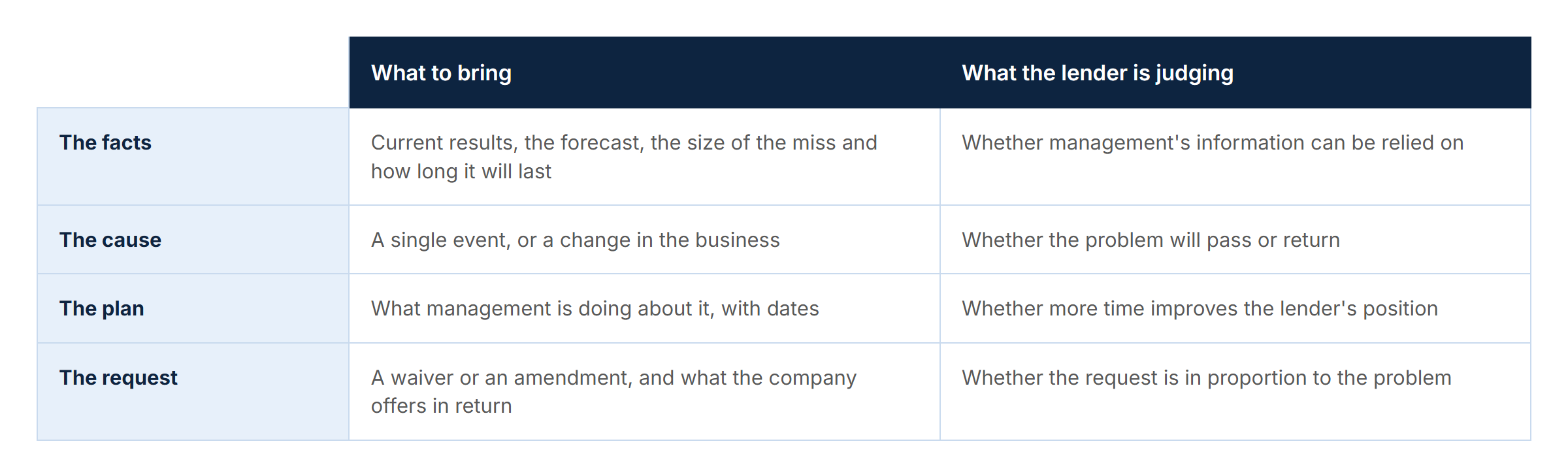
Four things belong in the conversation:
- The facts. Current results, the forecast, the size of the miss and how long it is expected to last.
- The cause. Whether this is a single event or a change in the business.
- The plan. What management is doing about it, with dates.
- The request. What the company is asking for, and what it offers in return.
Waivers and amendments
A waiver is the lender’s agreement not to act on a particular breach. An amendment changes the covenant for the future.
Either usually has a price: a fee, a higher rate, more frequent reporting or a contribution from the owners. Sometimes a lender agrees to hold off using its rights for a period while the company carries out a plan.
Whatever is agreed should be in writing. Reassurance in a conversation is not a waiver.
Credibility
Every forecast given to a lender is later compared with what happened. A company that misses its own revised forecast loses credibility quickly.
It is better to give a forecast that can be met than one that pleases for a week. Where there is more than one lender, each should hear the same facts.
A forecast given to a lender is a promise. Give one that can be kept.
When the stress points to something larger
A single miss after an unusual quarter is a matter for a waiver. Repeated misses say something else: the capital structure no longer fits the business.
Then the question is not the next waiver. It is whether the company needs new capital, a recapitalization or a sale.
Your next step
Forecast each covenant for the next four test dates. Where a miss is possible, prepare the four items above before calling the lender: the facts, the cause, the plan and the request.
The next piece in this series looks at stakeholder complexity, and how many parties are brought to one decision.
This article is general information. It is not investment, legal or tax advice, and it is not an offer to buy or sell any security.
Securities are offered through GT Securities, Inc. | Member FINRA, SIPC