
A company has a sale under negotiation, a refinancing in process or a funding round a few months from closing. It needs capital before that event arrives.
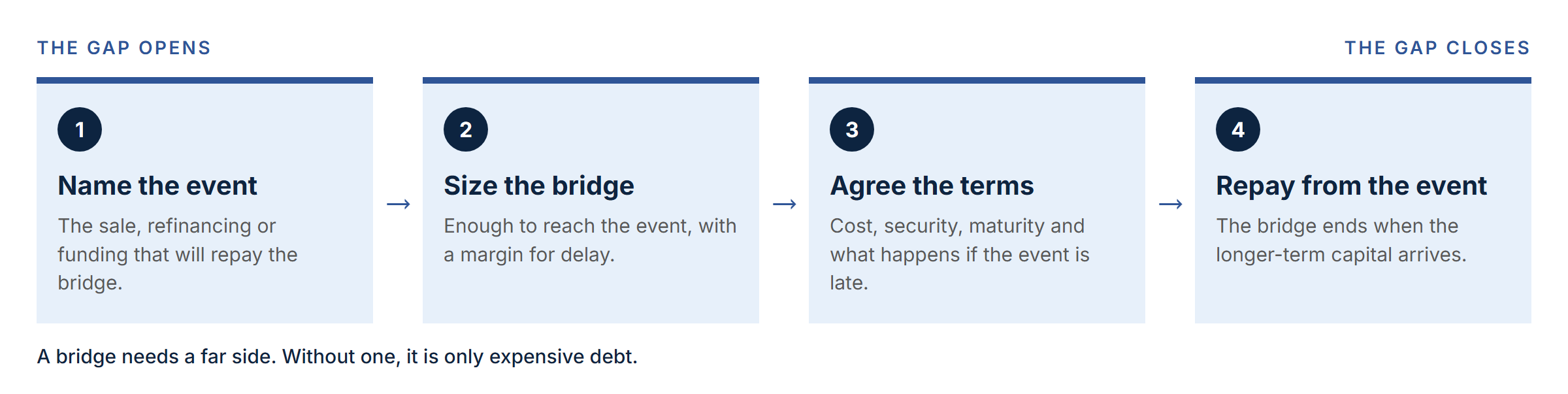
Bridge financing covers the gap. It is short-term capital, provided on the expectation that a specific event will repay it.
A bridge is defined by what stands on its far side. That is the first thing any provider will ask about.
When a bridge makes sense
A bridge fits when three things are true. The need is temporary. The event that will repay it is identifiable. The cost of waiting without capital is greater than the cost of the bridge.
Common cases include a loan that matures before a sale can close, an acquisition that must be completed before permanent financing is arranged, and a company that needs working capital to reach a funding round already under way.
In each, the bridge buys time for something that is already in motion.
When it does not
A bridge does not fit when no event is in view. Short-term capital used to cover continuing losses is not a bridge. It is expensive debt with an early maturity.
It also fits poorly when the event depends on things outside the company’s control and no alternative exists if it fails.
A bridge needs a far side. Without one, it is only expensive debt.
What it costs
Bridge capital is expensive, for good reason. The provider is lending quickly, for a short time, against an event that may be delayed.
The cost has several parts: the interest rate, fees at the start and at the end, and sometimes a rate that rises the longer the bridge stays out. Some bridges carry a right to convert into equity or to receive warrants.
Because the term is short, fees weigh more heavily than they would on a long loan. The cost should be worked out in total, over the period the bridge is likely to be outstanding.
Who provides it
The source depends on the situation.
- Existing lenders may extend or add to their loans to give a process time to finish.
- Existing investors often bridge a company to its next round, commonly with a note that converts into that round.
- Specialized lenders provide bridge loans against assets, property or a pending transaction.
- The other side of a transaction, such as a buyer, sometimes advances funds to keep a company stable until closing.
Each will want to know what the others are doing. A bridge from existing investors tells an outside party that those closest to the company still support it.
The terms that matter
Maturity and extension. Events slip. The term should allow for delay, and the right to extend, with its cost, should be agreed at the start.
Security. What the bridge is secured by, and how it ranks against existing debt. Existing lenders may need to consent.
Repayment. Whether the bridge must be repaid from the proceeds of the event, and whether early repayment carries a charge.
If the event fails. What the provider may do if the sale, refinancing or round does not happen. This is the term that decides how much risk the company has taken.
Plan for delay
Most bridges are repaid as planned. The ones that cause harm are those where the event was later than expected and the terms gave no room.
A company should size the bridge for a realistic delay, not for the plan. It should also know, before signing, what it would do if the event did not occur at all.
The bridge is priced on the plan. The company should arrange it for the delay.
Your next step
Before seeking a bridge, write three things on one page: the event that will repay it, the date it is expected and the evidence that it will happen. Then add what happens if it is three months late. A provider will ask for all four.
This piece completes the series on individual instruments.
This article is general information. It is not investment, legal or tax advice, and it is not an offer to buy or sell any security.
Securities are offered through GT Securities, Inc. | Member FINRA, SIPC