
Some owners sell their company twice.
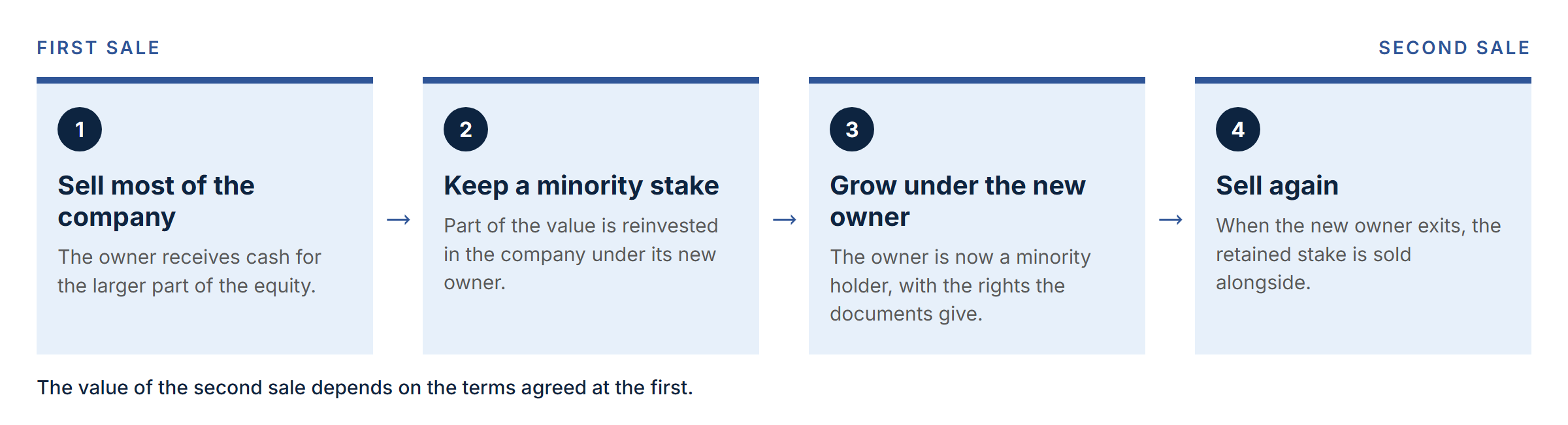
In the first sale, the owner sells most of the company and reinvests part of the proceeds in it, alongside the new owner. In the second, years later, the new owner sells the company again and the retained share is sold with it.
The retained share is called rollover equity. It is most common when the buyer is a private equity firm.
Why buyers ask for it
A buyer that asks the owner to roll over equity wants three things.
It wants the owner’s continued interest in the result, especially if the owner will stay to run the business. It wants a sign that the owner believes in the company’s future. It also needs less cash to complete the purchase.
For the buyer, an owner who keeps nothing is an owner who has less reason to care what happens next.
Why owners agree
For the owner, a rollover is a chance to share in what the company becomes with more capital and a new partner. If the company grows and is sold again at a higher value, the retained share can be worth a meaningful amount.
It may also be possible to defer tax on the part of the value that is rolled over. That depends on how the transaction is structured and is a question for the owner’s tax advisor.
There is a cost. The rolled portion is not cash. It is an investment in a private company the owner no longer controls.
The owner sells control and keeps risk. The terms decide whether that risk is fairly rewarded.
What the owner now holds
After the sale, the owner is a minority shareholder. Three features of the new position deserve attention.
The security. The buyer may hold a class of shares that is paid before the owner’s. If so, the two do not share equally in a modest outcome.
The debt. The company is likely to carry more debt than it did before. Debt is repaid before any shareholder.
The price. The rollover is usually valued at the price of the sale. The owner should confirm that the share is being issued on the same terms as the buyer’s own investment, or understand the difference.
The rights of a minority holder
A minority shareholder has the rights the documents give and few others. The ones that matter most are these:
- Information. Regular financial statements and notice of major events.
- Tag-along. The right to sell on the same terms when the majority owner sells.
- Drag-along. The majority’s right to require the minority to sell. This is usual, and its terms should be read.
- Protection against dilution. The right to take part when new shares are issued.
- A seat or a voice. Sometimes a board seat or observer role, more often for larger stakes.
The owner should also ask what happens to the shares if the owner’s employment ends. Some agreements allow the company to buy them back, and the price can depend on the reason for leaving.
The second sale
The owner does not control when the second sale happens. The majority owner decides, on its own schedule.
It may come sooner or later than the owner would like. Until then, the shares cannot easily be sold to anyone else.
An owner who needs the full value of the company in cash, on a known date, should roll over little or nothing.
Rollover equity is worth what the second sale pays. The owner does not choose the day.
Your next step
Before agreeing to a rollover, ask for a summary of the capital structure after closing: every class of shares, the debt and the order in which each is paid. Then ask what the retained share would be worth across a poor, a fair and a good second sale.
The next piece in this series covers unitranche loans, where one lender takes the place of two.
This article is general information. It is not investment, legal or tax advice, and it is not an offer to buy or sell any security.
Securities are offered through GT Securities, Inc. | Member FINRA, SIPC