
A buyer agrees on a price and cannot fund all of it at closing. The bank will lend only so much, and the buyer’s own equity covers only part of the rest.
The seller can fill the gap by accepting part of the price as a promise to pay later. That promise is a seller note.
The seller has sold the company and become one of its lenders on the same day.
Why sellers agree to it
A seller note can make a sale possible at a price the buyer could not otherwise pay. It can also widen the field of buyers to include those with less capital, such as a management team.
It tells the buyer and the bank something as well. A seller who is willing to wait for part of the price is showing confidence in the business.
The seller earns interest on the note. Receiving the price over time may also change when tax is due, which is a question for the seller’s tax advisor.
Standing behind the bank
The central fact about a seller note is its position. The bank that funds the purchase will require the seller’s note to rank behind its own loan.
That is set out in a subordination agreement between the bank and the seller. It usually provides that the bank is paid first, and that payments on the seller note stop if the company defaults on the bank loan or breaches its covenants.
It may also prevent the seller from taking action to collect for a period, even when the note is in default.
A seller should read this agreement as closely as the note. It decides what the note is worth when the company is under pressure.
A seller note is a loan to a company the seller no longer controls, ranked behind a bank the seller did not choose.
Security
A seller note may be secured or unsecured. Where there is security, it usually sits behind the bank’s: a second claim on the company’s assets, or a pledge of the shares that were sold.
Some sellers obtain a guaranty from the buyer or its owners. A guaranty from a party with real assets can matter more than a second claim on assets already pledged to a bank.
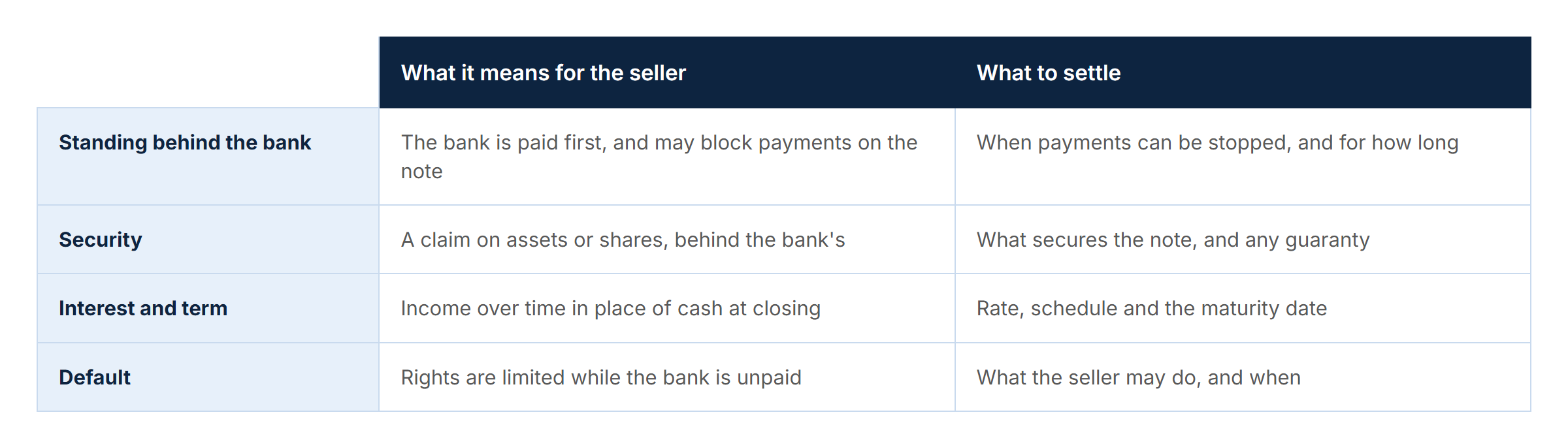
The terms to settle
Beyond its position and security, a note has ordinary loan terms, and each is negotiable:
- Interest. The rate, and whether it is paid in cash or added to the balance.
- Repayment. Regular installments, or a single payment at the end.
- Maturity. Often set to fall after the bank loan is due, at the bank’s insistence.
- Information. The seller’s right to receive the company’s financial statements while the note is outstanding.
- Default. What counts as one, and what the seller may do about it within the limits the bank has set.
A right to information is easy to overlook. A lender who cannot see the company’s results learns of trouble late.
Weighing a note against cash
A note is not the same as cash, and an offer that includes one should be compared with that in mind.
The questions are those any lender would ask. Can the business carry the bank loan and the note together? How much of the buyer’s own money is at risk ahead of the seller? What would the seller recover if the business failed?
Two offers at the same headline price can differ greatly in what the seller is likely to collect.
The headline price includes the note. What the seller receives depends on whether the note is paid.
Your next step
If an offer includes a seller note, ask for the proposed terms of the bank’s subordination agreement before agreeing to the price. Then ask an advisor to estimate what the note is worth to you today, not at its face amount.
The next piece in this series covers rollover equity, where the owner keeps a share of the company after the sale.
This article is general information. It is not investment, legal or tax advice, and it is not an offer to buy or sell any security.
Securities are offered through GT Securities, Inc. | Member FINRA, SIPC