
A seller believes the company is about to grow. The buyer is willing to pay for growth once it has happened.
An earn-out is how the two meet. Part of the price is paid at closing. The rest is paid later, if the company reaches agreed targets under its new owner.
It is a useful instrument and a frequent source of dispute. Which one it becomes depends on how it is written.
Why earn-outs are used
Earn-outs appear when buyer and seller disagree about the future and neither is being unreasonable.
The company may have a new product, a large contract not yet signed or a recent jump in earnings. The seller wants to be paid for it. The buyer does not want to pay for something that may not arrive.
An earn-out lets each act on its own view. If the seller is right, the seller is paid. If not, the buyer has not overpaid.
What is measured
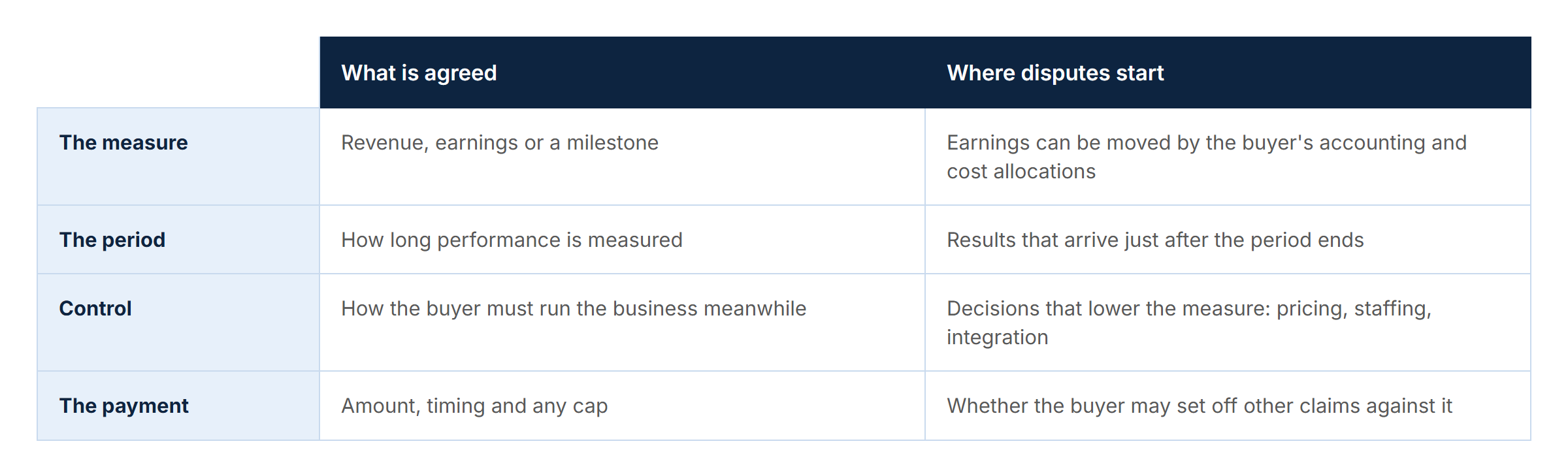
The measure is the first decision. The common choices are revenue, earnings or a defined milestone, such as a signed contract or a regulatory approval.
Each has a weakness. Revenue is simple to measure, and it can be reached by selling at a loss. Earnings reflect what the buyer cares about, and they depend on many accounting choices the buyer will control.
A milestone is the clearest of the three. It either happened or it did not.
Sellers usually prefer measures high on the income statement, where fewer of the buyer’s decisions can affect them.
Who controls the outcome
After closing, the buyer runs the company. Its decisions on pricing, staffing, investment and integration all affect whether the target is reached.
A seller should ask what the buyer has agreed to do, and not to do, during the earn-out period. Without such terms, the buyer may make reasonable business decisions that happen to reduce the payment.
A buyer, for its part, will resist terms that prevent it from running the business it has just bought. The agreement has to find a position both can accept.
An earn-out measures the company’s performance. The buyer controls the company.
The period and the payment
Earn-out periods commonly run from one to three years. A longer period gives the business more time to reach the target. It also extends the time during which the two parties are bound together.
The payment terms need the same precision as the measure. Is the payment all or nothing, or does it rise in steps? Is there a cap? When is it calculated, by whom and from which accounts?
The seller should also know whether the buyer may deduct other claims from the earn-out, and whether the payment is secured in any way.
When the seller stays on
Many sellers remain in the business during the earn-out. That gives them some influence over the result.
It also raises questions. What happens to the earn-out if the seller is dismissed, or leaves? How the payment is treated for tax can depend on whether it is tied to continued employment. That question belongs with a tax advisor before the terms are agreed.
Reducing the risk of dispute
Three practices help. Define the measure by reference to the company’s past accounting, with worked examples attached to the agreement. Agree in advance how disagreements over the calculation will be resolved, usually by an independent accountant. Keep the earn-out to a share of the price the seller could accept losing.
Treat the cash at closing as the price. Treat the earn-out as a possibility.
Your next step
If an offer includes an earn-out, write down what the company would have to do to earn it in full, and which of those steps the buyer will control after closing. Bring that list to counsel before responding.
The next piece in this series covers seller notes, where the owner lends part of the price to the buyer.
This article is general information. It is not investment, legal or tax advice, and it is not an offer to buy or sell any security.
Securities are offered through GT Securities, Inc. | Member FINRA, SIPC