
Once the facts are established, a special situation usually ends in one of four ways: a sale, new capital, a recapitalization or a negotiated workout.
Owners often begin with a preference. They want to keep the company, or they want to be done with it.
The preference matters. It does not choose the path. The facts do.
Three facts that decide
Three facts carry most of the weight:
- Value against debt. Is the business or the asset worth more than what is owed? If so, the owners have value to protect and room to choose. If not, the lenders’ consent governs most outcomes.
- The soundness of the business. Is the problem the capital structure, or the business itself? New capital can fix too much debt. It cannot fix falling demand.
- Time. Which paths can be completed before the deadline?
Each path below fits a different set of answers.
A sale
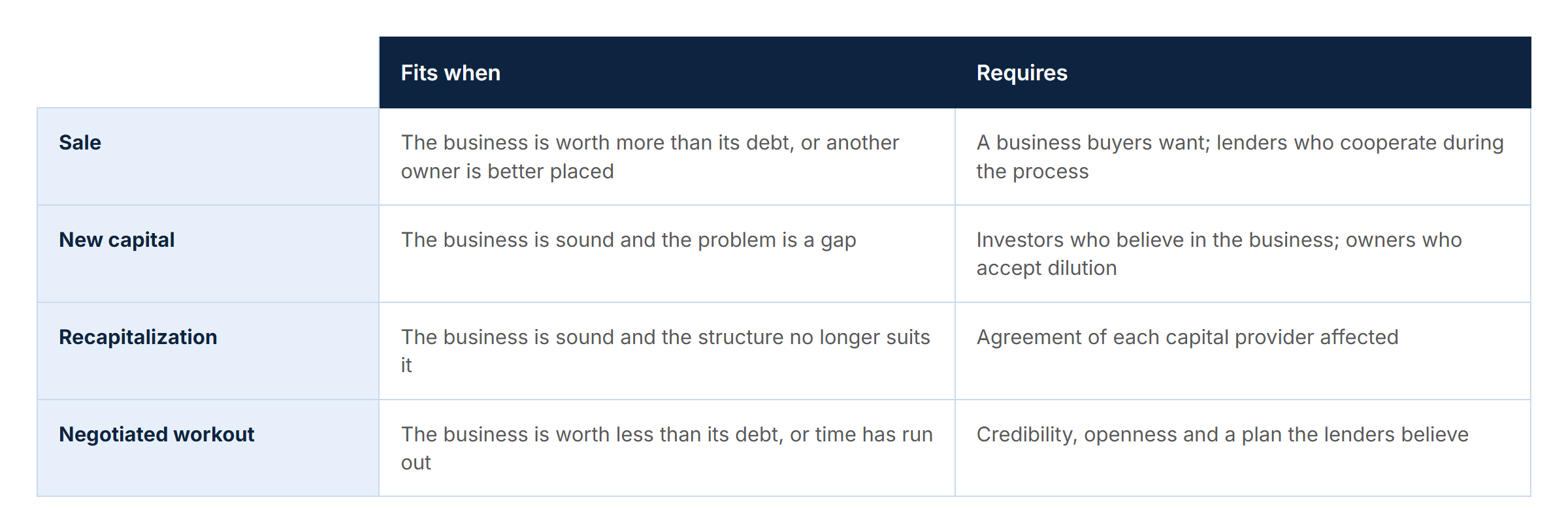
A sale fits when the business is worth more than its debt, or when another owner is better placed to run it. It also requires owners who are ready to leave and enough time for a process, even a short one.
A sale repays the lenders and returns what remains to the owners. It needs a business that buyers want and lenders who will cooperate while the process runs.
New capital
New capital fits when the business is sound and the problem is a gap: a maturity, a single loss or growth the company cannot fund.
It needs investors who believe the business works once the capital is in. It also needs owners who accept a smaller share and a new party with rights.
Investors ask one question early. Does their money go into the business, or out to existing lenders?
A recapitalization
A recapitalization rearranges the capital the company already has. New debt replaces old on different terms. Maturities move. Lenders may exchange what they hold for a different instrument, and owners may contribute.
It fits a sound business whose structure no longer suits it. It needs the agreement of each capital provider affected, and it is often combined with new capital.
A negotiated workout
A workout is an agreement with lenders, and sometimes other creditors, to change the terms outside of court. Payments may be reduced for a period, maturities extended or assets sold in an orderly way over time.
It fits when the business is worth less than its debt, or when time has run out for the other paths. Lenders agree when they conclude that an agreed solution recovers more than enforcement would.
A workout is a negotiation and not a surrender. Enforcement has costs and limits for a lender too.
Paths are often combined
Real outcomes mix these. An extension gives time for a sale. New capital arrives alongside an amended loan.
Whatever the combination, each alternative is compared on the same basis: what each party receives, when and with how much certainty.
The owner’s preference matters. The facts choose the path.
When to decide
The path is chosen once the facts are known, and not long after. Waiting feels safe and is not. Options expire one by one while a decision is deferred.
Indecision is also a choice. It is made by the calendar.
Your next step
Answer three questions in writing, as honestly as possible. Is the business worth more than it owes? Is the business itself sound? How much time is left? Take the answers to an adviser before taking a position with a lender or a buyer.
This piece completes the series on special situations.
This article is general information. It is not investment, legal or tax advice, and it is not an offer to buy or sell any security.
Securities are offered through GT Securities, Inc. | Member FINRA, SIPC