
A normal sale or financing takes months. Sometimes the months are not available. A loan matures in ten weeks. Cash runs short sooner. A buyer’s offer has an expiry date.
A short timeline does not make a transaction impossible. It changes which parts of the process can be kept, which can be shortened and which cannot be touched.
Knowing the difference is what separates a fast process from a careless one.
What time pressure changes
Fewer parties can be approached. Those who are approached know there is a deadline and take it into account. There is less room to negotiate and less time to correct a mistake.
Speed has a price. Under pressure, a company is usually paying for certainty and giving up the last increment of value.
What can be shortened
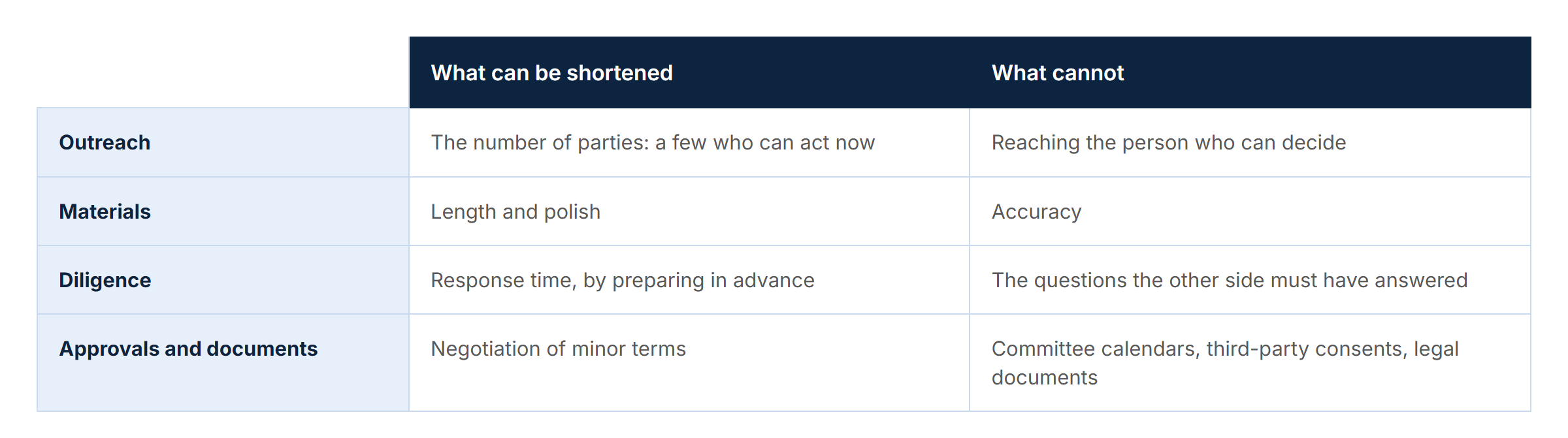
Four parts of a process compress well:
- Outreach. Approach a small number of parties already known to be able to act. They know the sector, have capital available and can decide quickly.
- Materials. A short, factual package takes the place of a full memorandum.
- Diligence. The data room is prepared before first contact, and the obvious questions are answered in advance.
- Negotiation. The company decides beforehand which terms matter and concedes the others quickly.
What cannot be shortened
Other parts do not compress, and a plan has to be built around them:
- Accuracy. A wrong number found later ends a fast transaction faster than a slow one.
- The other side’s approvals. Investment committees and credit committees meet on their own calendars.
- Third-party consents. Landlords, lenders and key customers answer in their own time.
- Outside reports. An appraisal or an accounting review takes as long as it takes.
- Legal documents. They have to be right, so counsel is engaged on the first day.
The first step in a short process is to learn these calendars, because they set the real timeline.
Choose counterparties for certainty
In a compressed process, the best counterparty is the one that will close. It has done similar transactions, has the funds and has a short chain of decision.
It is fair to ask directly how the approval works and what could stop it. A higher offer with an uncertain closing is the weaker offer.
Under time pressure, the best offer is the one that closes.
Run the work in parallel
A normal process runs in sequence. A fast one runs in parallel. Documents are drafted while diligence continues. Conversations with the lender run beside conversations with buyers. A second option is kept alive until the first has closed.
This takes coordination. One person keeps the calendar and checks it every day.
Buy time where it can be bought
Often the most useful first step is a small amount of extra time: a short extension from the lender, or bridge funding from the owners.
Lenders are more willing to give time to a process that is already underway and has clear milestones. A few added weeks, obtained early, can change the outcome.
Keep people informed
Under pressure, silence is read as bad news. Short, regular updates to the lender and the other key parties keep them from acting alone.
A fast process keeps accuracy and gives up polish.
Your next step
Write down the deadline, then list everything that must happen before it and who is responsible for each item. Mark the items that no one inside the company controls. Those set the timeline, and they are the first calls to make.
The final piece in this series covers how the facts point to one of four paths: a sale, new capital, a recapitalization or a workout.
This article is general information. It is not investment, legal or tax advice, and it is not an offer to buy or sell any security.
Securities are offered through GT Securities, Inc. | Member FINRA, SIPC