
The buyer with the strongest interest in a middle-market company is sometimes in another country. A foreign company may want a position in the market, a technology or a brand, and may value it more highly than a domestic buyer would.
A sale to a buyer abroad follows the same stages as any other. The differences lie in how long each stage takes, who must approve and what can go wrong between signing and closing.
None of this is a reason to leave foreign buyers off the list. Each is a reason to plan.
Why buyers abroad pay attention
For a company outside the country, buying an established business is often the fastest way in. It brings customers, people, licenses and a local reputation that would take years to build.
That strategic reason can support a strong price. It also means the buyer is likely to keep the business running much as it is.
Timelines and decisions
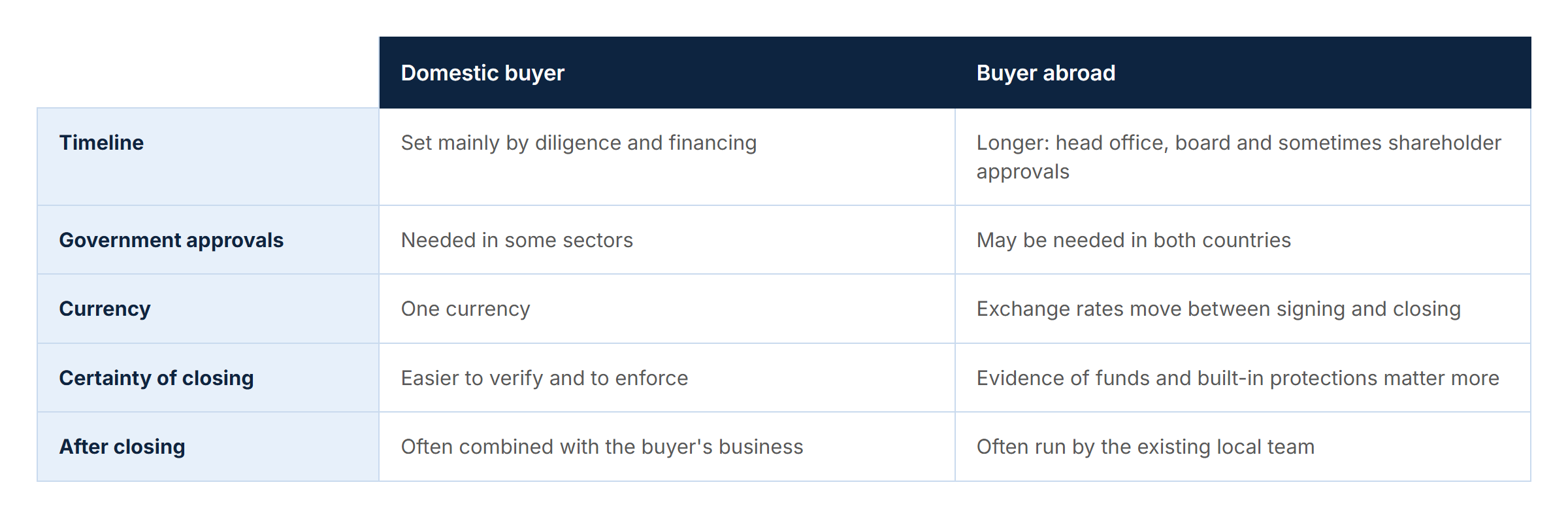
Decisions take longer. The head office, its board and sometimes its shareholders must approve. Advisers work in two countries, across time zones and languages.
The people a seller meets first may not have authority to commit. It is reasonable to ask a foreign buyer early to describe its approval steps and how long each usually takes.
Government approvals
Some countries review foreign acquisitions in sensitive sectors. A buyer’s home country may also require approval before money is invested abroad.
A review adds time between signing and closing, and its outcome is not in either party’s control. Which side carries the risk if approval is delayed or refused is a term to negotiate.
Currency and payment
The price may be set in one currency and funded from another. Exchange rates move between signing and closing, and the agreement should say who carries that movement.
Moving a large sum across a border can itself take time or need approval. Evidence of funds matters more than it does with a domestic buyer.
Certainty of closing
A seller should look closely at whether a foreign buyer can complete what it signs. Five questions are worth asking early:
- Who approves this acquisition, and in what order?
- Has the company bought a business in this country before?
- Which government approvals are needed, in either country?
- Where are the funds, and in what currency?
- Which entity will sign, and who stands behind it?
Enforcing an agreement against a party abroad is harder than against one at home. Protections are therefore better built in at the start, such as a deposit, a guarantee from the parent company or a local entity as the signing party.
With a buyer abroad, certainty of closing deserves as much attention as price.
After closing
A foreign buyer often has no local management of its own. It tends to rely on the existing team, which can mean continuity for employees and for the company’s name.
The company will report to a distant parent with its own customs. Decisions may be slower, more formal or less direct than the team is used to. An owner who plans to stay should ask how decisions will be made.
Structure and tax
A foreign buyer frequently acquires through a subsidiary formed in the seller’s country. Where part of the price is paid in the shares of a foreign company, the tax and resale consequences need advice before the letter of intent is signed.
The stages are the same. The time each takes, and who must approve, are not.
Your next step
Add to the buyer list the foreign companies that already sell to, buy from or compete with the business. Beside each, note whether it has made an acquisition in this country before. Those that have are the easier ones to assess.
This piece completes the series on selling a middle-market company.
This article is general information. It is not investment, legal or tax advice, and it is not an offer to buy or sell any security.
Securities are offered through GT Securities, Inc. | Member FINRA, SIPC