
An owner rarely wakes up and decides to sell. The idea arrives slowly. A buyer calls without being asked. A partner wants to retire. A hard year makes the next ten look long.
By the time advisers are called, the question is usually “what is the company worth?” It is a fair question. It is not the first one.
A sale process runs on the owner’s objectives. When those are unclear, the process drifts, and buyers sense it.
The work before the process is deciding what the owner wants from a sale.
What is the sale for?
Owners sell for different reasons. Some want to retire. Some want to turn wealth held in one company into something more diversified. Some need more capital than they can provide. Others face a health matter, a family change or a disagreement among partners.
Each reason points to a different transaction. An owner who wants to retire needs a buyer who can run the business without them. An owner who wants capital for growth may not need to sell control at all.
Stating the reason plainly is the first step, because every later choice depends on it.
How much, and in what form?
The headline price is one number. What the owner keeps is another.
Proceeds can arrive as cash at closing, as payments over time, as an earn-out tied to future results or as ownership kept in the company after the sale. Taxes, debt repayment and transaction costs come out before the owner is paid.
It helps to know the amount needed, after tax, before any offer arrives. That is a conversation with a tax adviser and a financial planner, and it is better held early.
What happens to the owner afterward?
Many buyers want the owner to stay for a transition. Some want the owner and the management team to keep running the company for years, often with a continuing ownership stake.
An owner should decide honestly whether working for someone else is acceptable, and for how long. A buyer’s plan and the owner’s plan need to match on this point.
What happens to the people and the name?
Owners often care about more than proceeds: the employees, the location, the brand and the customers who have relied on the company.
Some will accept a lower price from a buyer who will keep the business in place. That is a legitimate choice. It needs to be stated at the start, so that buyers are chosen with it in mind.
Price is one term. What the owner keeps, and what happens next, are the others.
Full sale, partial sale or recapitalization
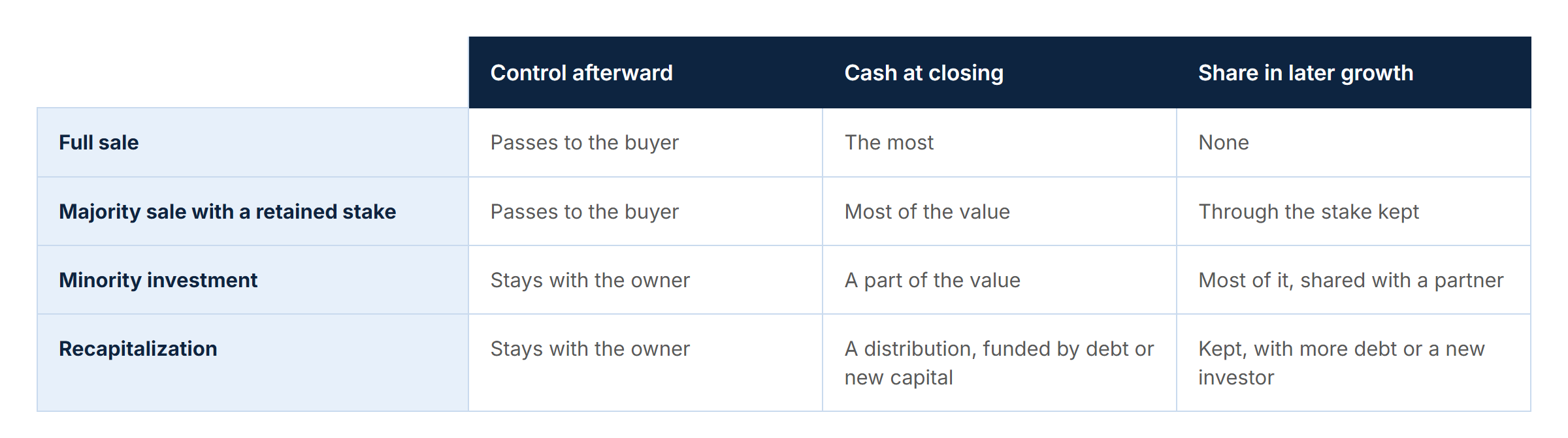
A sale of the whole company is not the only path. There are four common ones:
- A full sale. The owner sells everything. It is the cleanest exit and gives the most certainty about proceeds.
- A majority sale with a retained stake. The owner sells control, takes cash now and keeps a minority share in the company’s later growth.
- A minority investment. The owner sells a minority stake and keeps control, gaining a partner who will have rights of its own.
- A recapitalization. The company raises debt or new capital and pays a distribution to its owners, without a change of control.
The right path follows from the answers to the earlier questions. It should not be chosen first and justified afterward.
Timing: the company, the owner and the market
Three clocks run at once.
The first is the company’s. Buyers pay for the future and judge it by the recent past, so a company is best sold while results are rising and there is evidence of more to come.
The second is the owner’s: readiness to let go, and the energy to see a process through.
The third is the market’s. The availability of credit and buyers’ appetite for a sector change from year to year, and no owner controls them.
A common mistake is to wait for the perfect market while the company’s own best period passes.
Deciding to prepare is not deciding to sell. It keeps the choice open.
Your next step
Write the answers to five questions on one page: why sell, how much is needed after tax, what role the owner wants afterward, what must be protected and by when. Share the page with co-owners and family. Where their answers differ, resolve the difference before any conversation with a buyer.
The next piece in this series looks at what buyers pay for, and why two companies with the same earnings can be worth different amounts.
This article is general information. It is not investment, legal or tax advice, and it is not an offer to buy or sell any security.
Securities are offered through GT Securities, Inc. | Member FINRA, SIPC