
Owners tend to think about value as a multiple. A company in the industry sold for some multiple of its earnings, so theirs should too.
Buyers think about it differently. They are buying future cash flow, and the price reflects how confident they are that it will arrive.
Two companies with the same earnings can be worth very different amounts. The difference lies in a small number of drivers.
Most of them can be improved with time. That is the reason to understand them well before a sale.
Earnings quality: the number behind the number
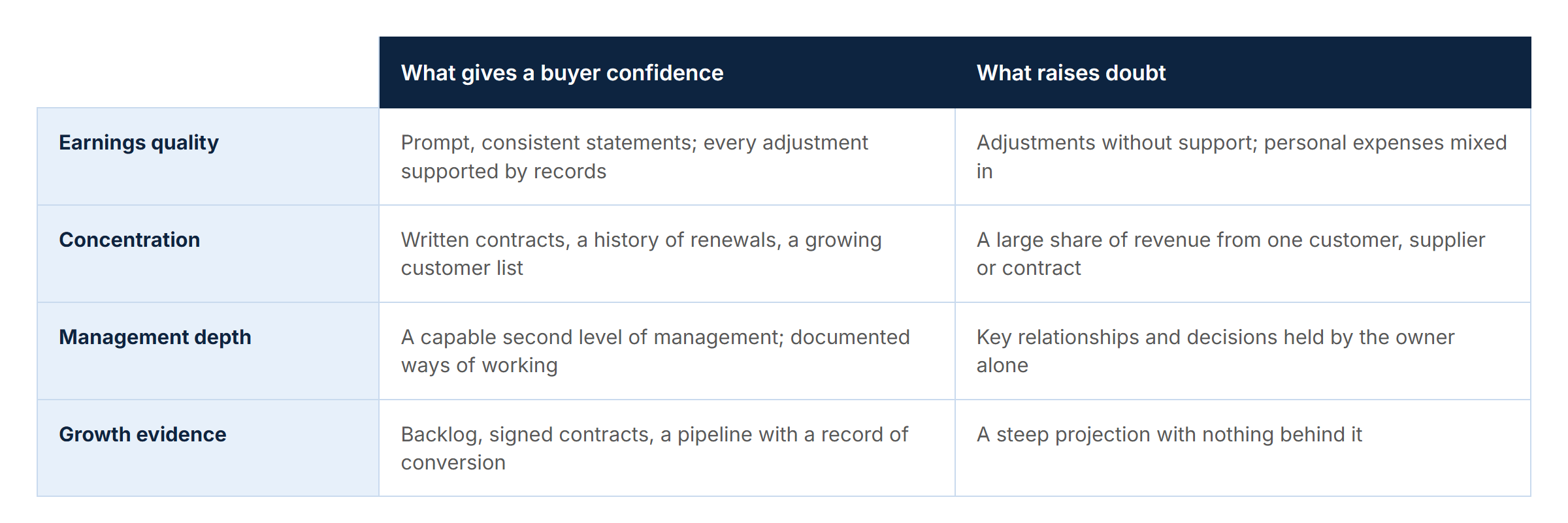
Buyers start with earnings and then adjust them. One-time items come out. So do an owner’s personal expenses, and pay that is above or below what a hired manager would earn.
Then the earnings are tested. A buyer’s accountants check how revenue is recorded, how much of it repeats and whether margins have held steady.
Every adjustment a seller claims has to be supported with records. An adjustment without support is discounted, and it lowers confidence in the rest.
Concentration: how much depends on a few
A company that earns a large share of its revenue from one customer carries a risk the buyer will price. The same applies to dependence on one supplier, one product or one contract.
Buyers respond in two ways. They lower the price, or they move part of it into payments that depend on the customer staying.
Written contracts, a history of renewals and a growing list of other customers all reduce the concern.
Management depth: can it run without the owner?
In many middle-market companies the owner holds the key relationships and makes the important decisions. A buyer sees that much of the value could leave with them.
Buyers pay more for a company with a capable second level of management and documented ways of working. Financial buyers depend on it, because they do not run companies themselves.
A business that depends on its owner is worth less to everyone except its owner.
Growth evidence: proof, not projection
Every seller projects growth. Buyers pay for the growth that is supported by evidence.
Evidence includes a backlog, signed contracts, a sales pipeline with a record of conversion, recent customer wins and capacity already paid for.
A steep projection with nothing behind it does more harm than a modest one. It makes the buyer doubt the other numbers too.
Other things buyers weigh
Beyond the four main drivers, several others move the price:
- Recurring revenue. Contracted or repeat revenue is valued above one-time sales.
- Margins against peers. Higher and steadier margins suggest pricing power or efficiency.
- Capital needs. A business that must reinvest heavily leaves less cash for its owner.
- Working capital. Slow collections and excess inventory tie up money a buyer has to fund.
- Legal and compliance record. Open disputes and gaps in licenses or filings become price adjustments.
Why the same company draws different prices
Value also depends on who is buying. A strategic buyer may count savings and sales it expects from combining the two businesses. A financial buyer prices to the return it needs, given the debt available and its plan for growth.
Competition matters as well. Several qualified buyers, each aware of the others, test value in a way no single negotiation can.
Value is a range until a process tests it.
Your next step
Rate the company honestly on the four main drivers: earnings quality, concentration, management depth and growth evidence. Pick the weakest. Then ask what twelve months of work would change about it, and whether that work is worth doing before a sale.
The next piece in this series compares strategic and financial buyers, and why a sale to one differs from a sale to the other.
This article is general information. It is not investment, legal or tax advice, and it is not an offer to buy or sell any security.
Securities are offered through GT Securities, Inc. | Member FINRA, SIPC