
Two offers arrive for the same company. One is from a larger competitor. The other is from a private equity firm. The prices are close.
They are not the same offer. One buyer is fitting the company into its own business. The other is buying a business to grow and sell again.
Nearly everything else follows from that difference: how each values the company, what each asks of the owner and what the company looks like three years later.
What a strategic buyer wants
A strategic buyer is an operating company. It may be a competitor, a customer, a supplier or a business in a neighboring market.
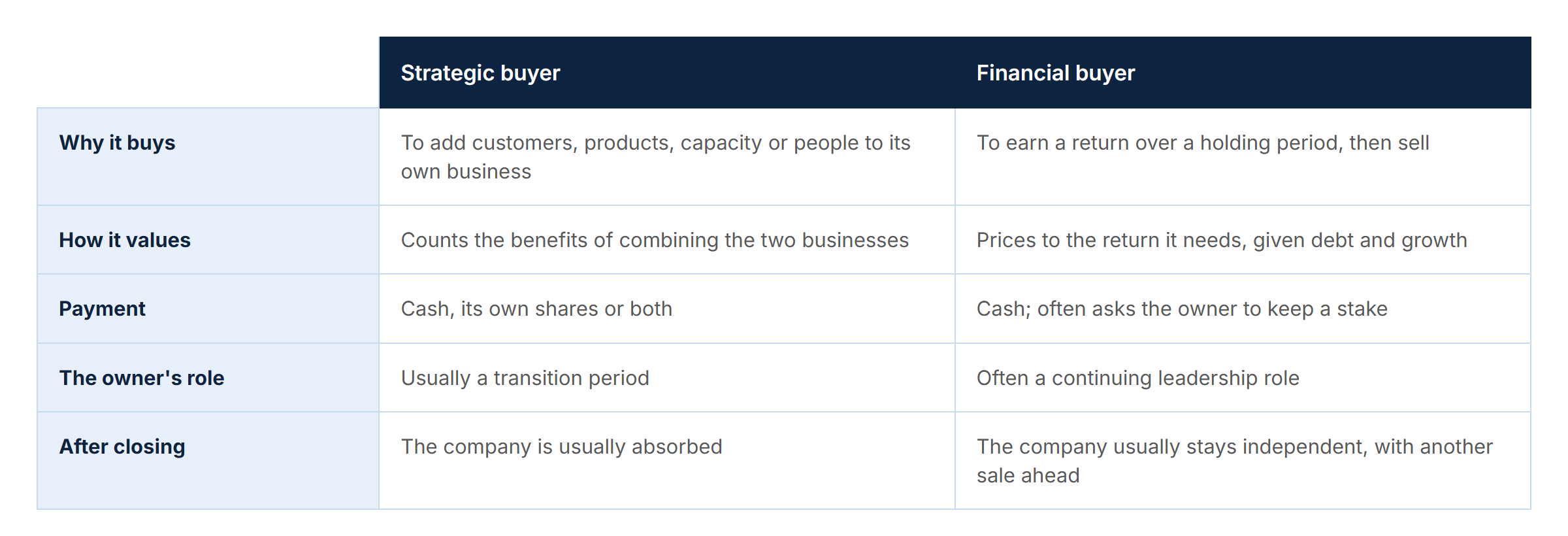
It buys for what the company adds to its own operations: customers, products, technology, capacity, people or a region. It usually intends to keep what it buys and to combine it with what it has.
What a financial buyer wants
A financial buyer is an investor, such as a private equity firm or a family office. It buys to earn a return over a holding period and then sells.
It does not run companies itself, so it needs a management team. It often funds part of the price with debt, and it usually arrives with a plan for growth that may include further acquisitions.
One variation is worth knowing. A financial buyer that already owns a company in the same industry may behave much like a strategic buyer.
How each arrives at a price
A strategic buyer can count the benefits of combining the two businesses: costs removed and sales added. That can support a higher price, though buyers rarely pay a seller for all of the benefit they expect.
A financial buyer works from the return it needs. The price depends on the debt available, the growth it believes in and what it expects at its own exit.
Either type can be the higher bidder. It depends on the fit, the company and the market at the time.
One buyer is fitting the company into its own business. The other is buying a business to grow and sell again.
How the terms differ
The two types tend to differ on four terms:
- Form of payment. A strategic buyer may pay in cash, in its own shares or both. A financial buyer usually pays cash and often asks the owner to keep a stake.
- The owner’s role. A strategic buyer typically wants a transition period. A financial buyer often wants the owner or the management team to keep leading.
- Diligence. A strategic buyer knows the industry and looks hard at how the businesses will combine. A financial buyer runs detailed financial diligence, and its lenders run their own.
- Certainty. A financial buyer’s offer may depend on its financing. A strategic buyer’s may depend on internal or regulatory approvals.
Life after closing
After a sale to a strategic buyer, the company is usually absorbed. Systems, the name and sometimes facilities are combined, and roles that overlap may be consolidated.
After a sale to a financial buyer, the company usually stays independent under its own name. There is more formal reporting and pressure to grow. There is also another sale ahead, in which an owner who kept a stake is paid a second time.
Neither outcome is better in itself. They suit different owners.
Confidentiality with competitors
A sale process that includes competitors needs particular care. A competitor that reviews the company and does not buy it still leaves with what it learned.
The usual answer is to release information in stages. Customer names, pricing and key contract terms are held back until late, and are shared only with the people who need them.
Which is right
The answer follows from the owner’s objectives. An owner who wants a clean exit and the highest price may lean toward a strategic buyer. An owner who wants a continuing role, an independent company and a second payout may lean toward a financial one.
It is usually not necessary to choose in advance.
The best answer often comes from inviting both types and comparing the full terms.
Your next step
For each type of buyer, write a few lines on what life looks like three years after closing: for the owner, for the management team and for the employees. Compare both pictures with the objectives set before the process began.
The next piece in this series covers preparation: the year of work that protects the price.
This article is general information. It is not investment, legal or tax advice, and it is not an offer to buy or sell any security.
Securities are offered through GT Securities, Inc. | Member FINRA, SIPC