
Buyers make an offer on what they are told. They close on what they find.
The gap between the two is where value is lost. A problem found in diligence leads to a lower price, money held back at closing or a buyer who walks away.
The same problem, fixed or disclosed in advance, is often a footnote.
Preparation is the work of closing that gap before a buyer opens it. It takes about a year to do well, and it is the part of a sale most fully in the owner’s control.
Financial reporting
Buyers and their lenders rely on the financial statements more than on anything else. Monthly statements should be produced promptly and on a consistent basis. Annual statements reviewed or audited by an outside accountant carry more weight than internal ones.
Personal expenses should come out of the business now, so they do not have to be explained later. Every adjustment to earnings needs a record behind it.
Some owners commission an independent review of their own earnings before going to market. It finds the questions first, while there is still time to answer them.
Contracts and customers
Many middle-market relationships run on purchase orders and long habit. Buyers prefer written agreements with the customers and suppliers that matter most.
Existing contracts should be read for what happens in a sale. Some require the other party’s consent before they can pass to a new owner, and that consent takes time to obtain.
Agreements with key employees deserve the same review, including confidentiality terms and ownership of what they create for the company.
Legal housekeeping
Diligence tests whether the company is what its records say it is. The basics need to be in order:
- Ownership records. A clear and complete record of who owns the company.
- Corporate records. Minutes, consents and filings brought up to date.
- Intellectual property. Written assignments showing the company owns what its people and contractors built.
- Licenses and permits. Current, and held in the right name.
- Disputes. Resolved where possible, and documented where not.
- Tax filings. Current in every place the company does business.
None of this is glamorous. Each gap, found late, becomes a negotiation.
The team
A buyer is also buying the people. The owner’s key relationships should be shared with others well before a sale, so that the business is seen to run without one person.
Plan how key managers will be kept through a transaction. Keep the number of people who know about the sale small.
The data room
A data room is the organized set of documents a buyer will ask for. Building it early has a second benefit: the empty folders show what is missing.
A company that answers diligence requests in days keeps a process moving. One that takes weeks gives a buyer time to reconsider.
Buyers make an offer on what they are told. They close on what they find.
A year, in order
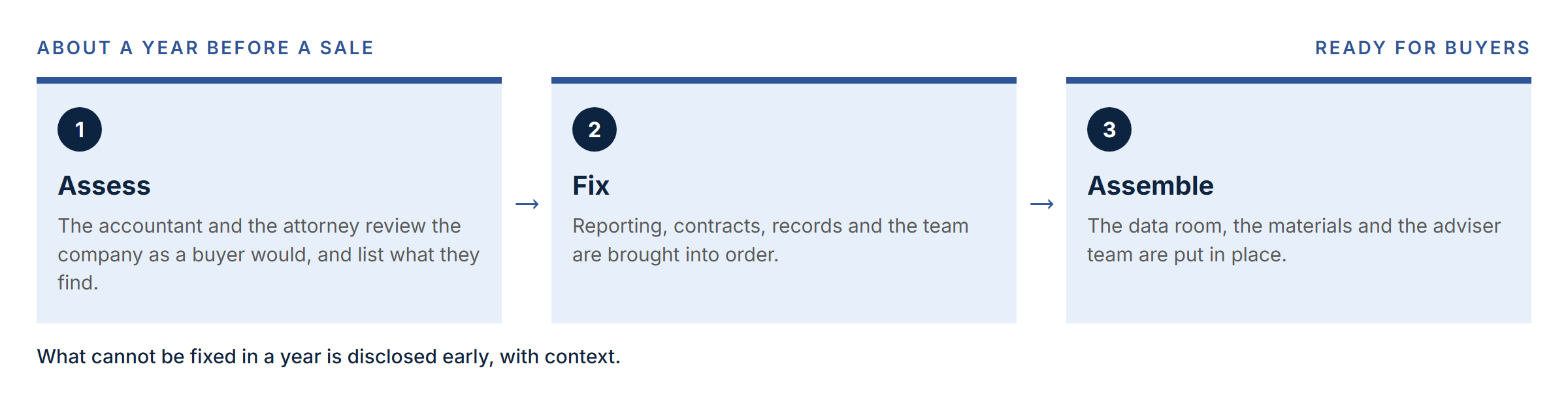
The work falls into three phases:
- Assess. In the first few months, the accountant and the attorney review the company as a buyer would and list what they find.
- Fix. Through the middle of the year, reporting, contracts, records and the team are brought into order.
- Assemble. In the final months, the data room, the materials and the adviser team are put in place.
What cannot be fixed gets disclosed
Some issues will not be solved in a year. A dominant customer or a pending lawsuit will still be there when buyers arrive.
Those are disclosed early and with context. Buyers price a known risk more calmly than a surprise.
A problem disclosed early is a term to negotiate. A problem discovered late is a reason to reprice.
Your next step
Ask the company’s accountant and its attorney the same question: if a buyer began diligence tomorrow, what would they find first? Their two answers are the start of the preparation list.
The next piece in this series covers running a competitive process without losing confidentiality.
This article is general information. It is not investment, legal or tax advice, and it is not an offer to buy or sell any security.
Securities are offered through GT Securities, Inc. | Member FINRA, SIPC