
After the letter of intent is signed, the buyer’s advisers arrive with a list of requests. It can run to hundreds of items.
Owners often experience this as an interrogation. It is better understood as the buyer confirming what it was told before it pays.
The outcome depends less on whether the company has problems. Every company does. It depends on whether the buyer learns of them from the seller or finds them alone.
What buyers test
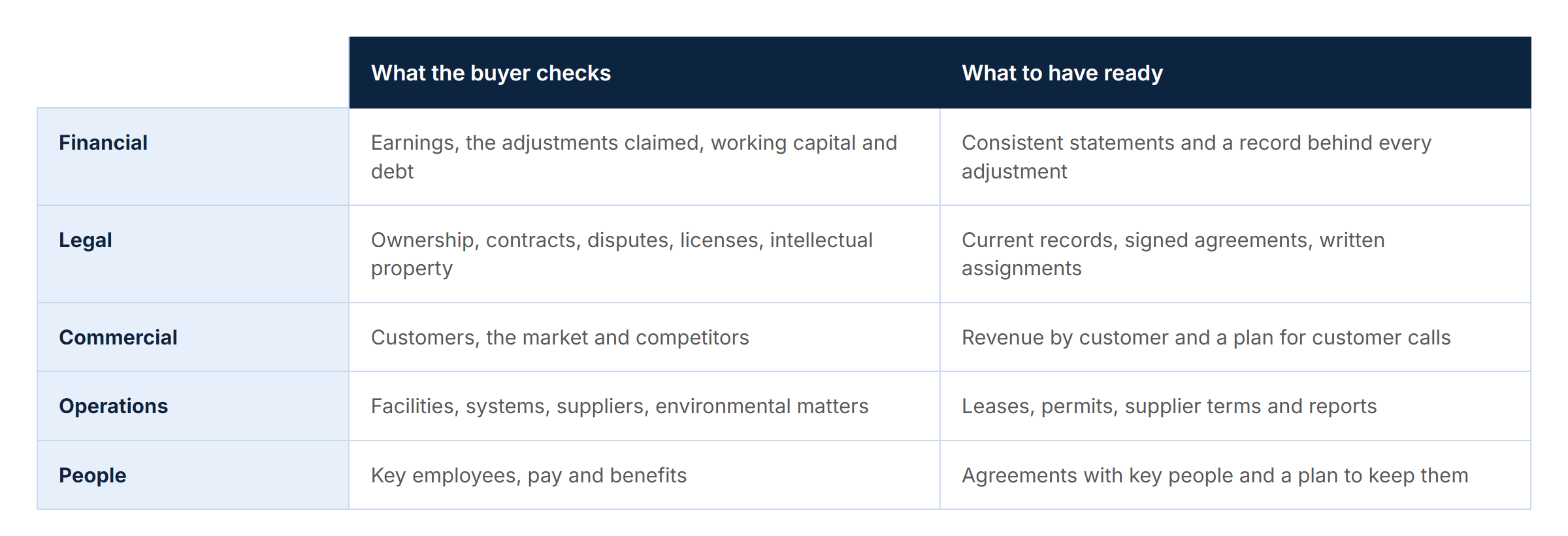
Diligence covers the whole company, usually in five areas:
- Financial. The earnings, the adjustments claimed, working capital and debt.
- Legal. Ownership, contracts, disputes, licenses and intellectual property.
- Commercial. Customers, the market and competitors, often including calls with key customers.
- Operations. Facilities, systems, suppliers and environmental matters.
- People. Key employees, pay, benefits and how the team works together.
Tax runs through all five.
Why a discovered problem costs more
A problem the buyer finds for itself costs more than the same problem disclosed, for three reasons.
The first is trust. A buyer that finds one undisclosed issue asks what else it has not been told. Diligence widens and slows.
The second is leverage. By this stage the seller has usually granted exclusivity. The other buyers have gone, and a request to lower the price is hard to refuse.
The third is momentum. The seller has spent months on the process, and people inside the company may know. Walking away is costly, and the buyer knows it.
A disclosed problem works differently. It was known when the offers were made, so it is already in the price.
A disclosed problem is priced while buyers are competing. A discovered one is priced after they have gone.
Preparing the answers
The work is done before the company goes to market. The seller’s own advisers review the business as a buyer would and list what they find.
Each known issue gets a short, factual answer: what happened, what it cost, what was done about it and why it should not recur. The supporting documents go in the data room.
The significant ones are disclosed early, in the memorandum or soon after. One person coordinates every response, so that answers stay consistent.
During diligence
Speed and accuracy both matter. “We will check” is a better answer than a guess. A mistake, once noticed, is corrected promptly and without being asked.
The business also has to keep performing. Buyers watch the monthly results closely during diligence, and a weak month invites a conversation about price.
When a buyer asks to reprice
Not every request to lower the price is opportunism. Some reflect a real finding.
Three questions help in judging one. Is the finding new? Is it material? Is the reduction asked for in proportion to it?
A specific protection is often a better answer than a general price cut. Money can be set aside for that one issue, or the seller can agree to cover it if it arises.
The seller’s strongest position is a real alternative. That is one more reason to prepare well and to end the competitive stage on good terms with the buyers who were not chosen.
Every company has problems. A buyer judges how they were handled and when they were disclosed.
Your next step
Write down the three questions you most hope a buyer will not ask. For each, prepare the answer and find the document that supports it. Then decide when in the process the buyer will be told.
The final piece in this series looks at what changes when the buyer is abroad.
This article is general information. It is not investment, legal or tax advice, and it is not an offer to buy or sell any security.
Securities are offered through GT Securities, Inc. | Member FINRA, SIPC