
A company that needs more debt than a bank will provide has traditionally borrowed twice: a senior loan from a bank, and a junior loan from a second lender at a higher rate.
A unitranche loan replaces both. One lender, or a small group acting as one, provides the whole amount under a single agreement at a single rate.
It has become a common way for private lenders to finance mid-sized companies, particularly in acquisitions.
How it works
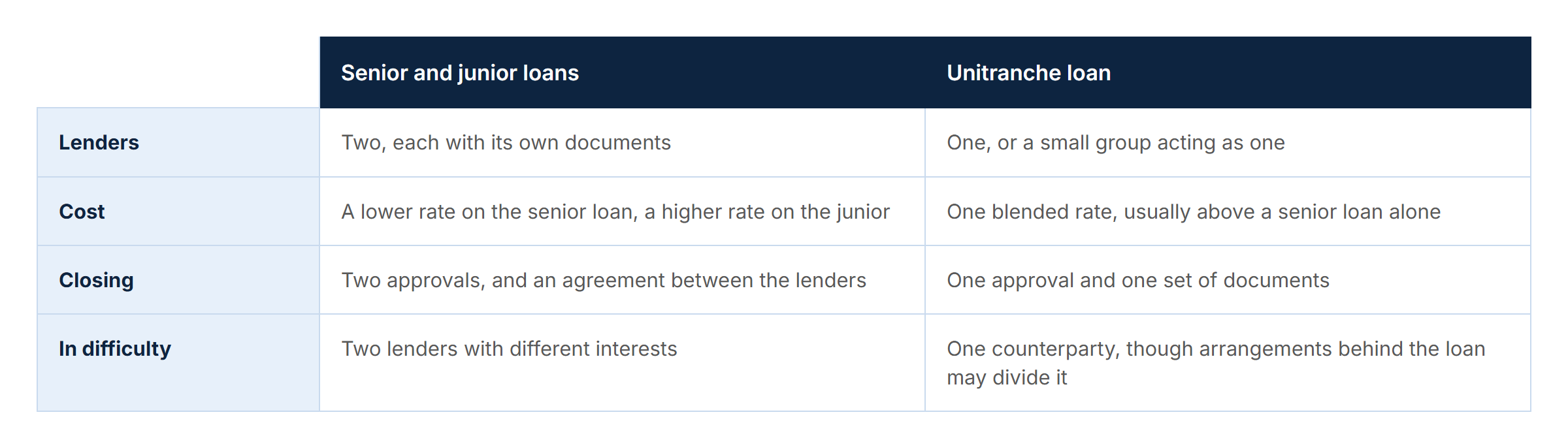
The borrower signs one loan agreement, grants one set of security and deals with one lender or agent. There is one interest rate, which falls between what a senior loan and a junior loan would each have cost.
The lender is taking both the safer and the riskier part of the debt. The blended rate pays it for the mix.
What the borrower gains
Speed. One lender means one approval. There is no second lender to bring in, and no agreement between two lenders to negotiate.
Certainty. In an acquisition, a seller prefers a buyer whose financing depends on one party.
Simplicity afterward. An amendment or waiver is requested from one counterparty.
Capacity. Unitranche lenders often lend more against a company’s earnings than a bank would alone.
What it costs
The rate on a unitranche loan is usually higher than the rate on a senior bank loan. A borrower who could have met its needs with senior debt alone will pay more for the same money.
The comparison that matters is with the blended cost of a senior and a junior loan together. On that basis a unitranche loan may cost a little more or a little less, and the borrower is paying for speed and simplicity.
Unitranche loans often carry fees for early repayment as well. A borrower who expects to refinance or sell within a few years should weigh them.
One loan in place of two means one negotiation in place of three: senior, junior and the agreement between them.
What sits behind the loan
A unitranche loan can look simpler than it is. The lender may divide the loan privately with another lender into a part that is repaid first and a part that is repaid last.
That division is set out in an agreement among the lenders. The borrower is usually not a party to it and may not see it.
In ordinary times this does not affect the borrower. In difficulty it can. The lenders behind the loan may have different interests, and the one the borrower speaks to may not be free to decide alone.
A borrower can ask whether such an arrangement exists and who holds the right to approve amendments.
Concentration
One lender is simpler than two. It is also a single point of dependence.
If the company needs more capital, flexibility on a covenant or patience in a weak year, everything rests on one relationship. The lender’s own circumstances, such as its appetite for the sector, matter more than they would in a group of lenders.
That makes the choice of lender more important than the last fraction of the rate.
With one lender, the borrower has one relationship. It had better be a good one.
When it fits
A unitranche loan suits a company that needs more debt than a bank will provide, values speed and certainty and has steady cash flow to carry the cost. It is often used in acquisitions and in buyouts backed by private equity.
It suits less well a company that can meet its needs with a bank loan, or one that expects to repay early.
Your next step
When comparing financing offers, set them side by side on four lines: total cost including fees, covenants, the cost of early repayment and who must agree to any amendment. The lowest rate does not always describe the best loan.
The next piece in this series covers preferred equity, which sits between a loan and a partner.
This article is general information. It is not investment, legal or tax advice, and it is not an offer to buy or sell any security.
Securities are offered through GT Securities, Inc. | Member FINRA, SIPC