
In most sectors, regulation is a cost of doing business. In health care and life sciences, it is part of the business.
A license, an approval, a provider agreement or a clean compliance record can be among a company’s most valuable assets. Their absence can make an otherwise good company hard to finance or sell.
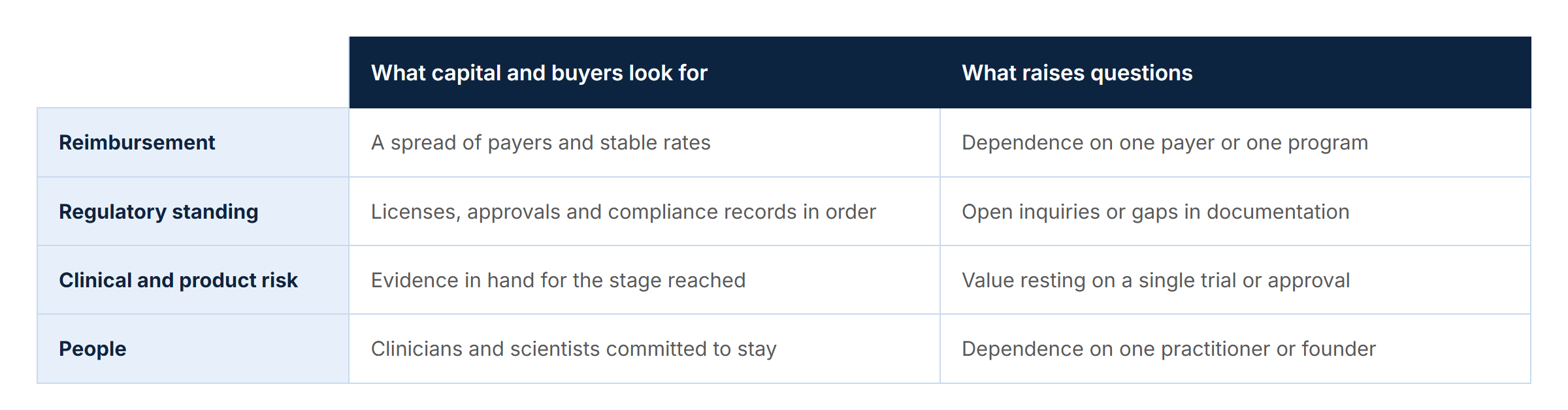
The sector covers very different businesses, from medical practices and care providers to device makers and drug developers. Investors and buyers ask all of them versions of the same four questions.
Who pays
In health care services, the patient is rarely the one who pays. Payment comes from government programs, insurers and employers, at rates the provider does not fully control.
Capital providers study the mix. They ask how much revenue comes from each payer, how stable the rates have been and how long payment takes to arrive.
Dependence on one payer or one program is a concentration, in the same way dependence on one customer would be elsewhere. A change in a single rate can change the company’s earnings.
They also look at how accurately the company bills and collects. Errors there are both a financial and a compliance matter.
Regulatory standing
Health businesses operate under licenses, certifications and rules about how they bill, refer, market and handle patient information.
Diligence in this sector goes deep into compliance. Buyers and investors review licenses, inspection results, billing practices, arrangements with referring physicians and the handling of patient data.
A problem found here can do more than lower the price. It can become the buyer’s liability after closing, so buyers are cautious and thorough.
Some states also limit who may own a medical practice. Those rules shape how investments are structured and belong with health care counsel from the start.
In health care, a compliance record is an asset. It is examined as closely as the financial statements.
Clinical and product risk
For companies developing drugs, devices or diagnostics, value depends on evidence and approval.
Investors ask what stage the product has reached, what data supports it and what remains before it can be sold. Each stage completed removes risk and changes who will invest.
They ask about the path after approval as well: who will pay for the product, at what price, and how it will reach patients. Approval without reimbursement is an incomplete answer.
A company whose value rests on one trial or one decision is financed differently from one with several products or with revenue already.
People
Health care is delivered by clinicians, and science is advanced by researchers. Both can leave.
Buyers and investors ask how much of the business depends on particular individuals, what agreements are in place with them and how they are expected to feel about a transaction.
In a practice or a clinical business, the commitment of the physicians is often a condition of the deal.
Who invests and who buys
The investors are specialized. Venture and growth funds with scientific expertise back product companies. Private equity firms with health care experience invest in services. Lenders familiar with reimbursement finance providers.
Strategic buyers are prominent: larger pharmaceutical and device companies, health systems, insurers and established service groups.
A generalist investor often declines a health care business because it cannot assess the regulatory risk. The ones who understand it are the ones to approach.
Preparing
Preparation in this sector starts with compliance. A company that reviews its own licenses, billing and data practices before a process, and corrects what it finds, removes the most common cause of delay.
For product companies, it means organizing the evidence and the regulatory record so that an expert reader can assess them quickly.
The buyer’s experts will review compliance. It is better that the company’s own experts review it first.
Your next step
List every license, certification and approval the business depends on, with its holder, its expiry and any condition attached. Then note which would need consent or renewal if ownership changed. That list is among the first things a buyer will request.
The next piece in this series covers aerospace and defense.
This article is general information. It is not investment, legal or tax advice, and it is not an offer to buy or sell any security.
Securities are offered through GT Securities, Inc. | Member FINRA, SIPC