Many developers build their first projects with money from people they know: friends, family and a circle of private investors.
That capital has limits. It arrives one project at a time, and each raise starts again from the beginning.
Institutional capital is different. A pension fund, an insurance company, an endowment or a real estate fund can commit to several projects at once. It also asks more of the developer, and it asks before it invests.
What institutions are buying
An institution is investing other people’s money under its own rules. It has to explain every decision to a committee, and later to the people whose money it manages.
It is therefore buying two things. One is the project. The other is confidence that the developer will do what was promised and report on it accurately.
A good project from a developer the institution cannot assess is hard for it to approve.
Track record
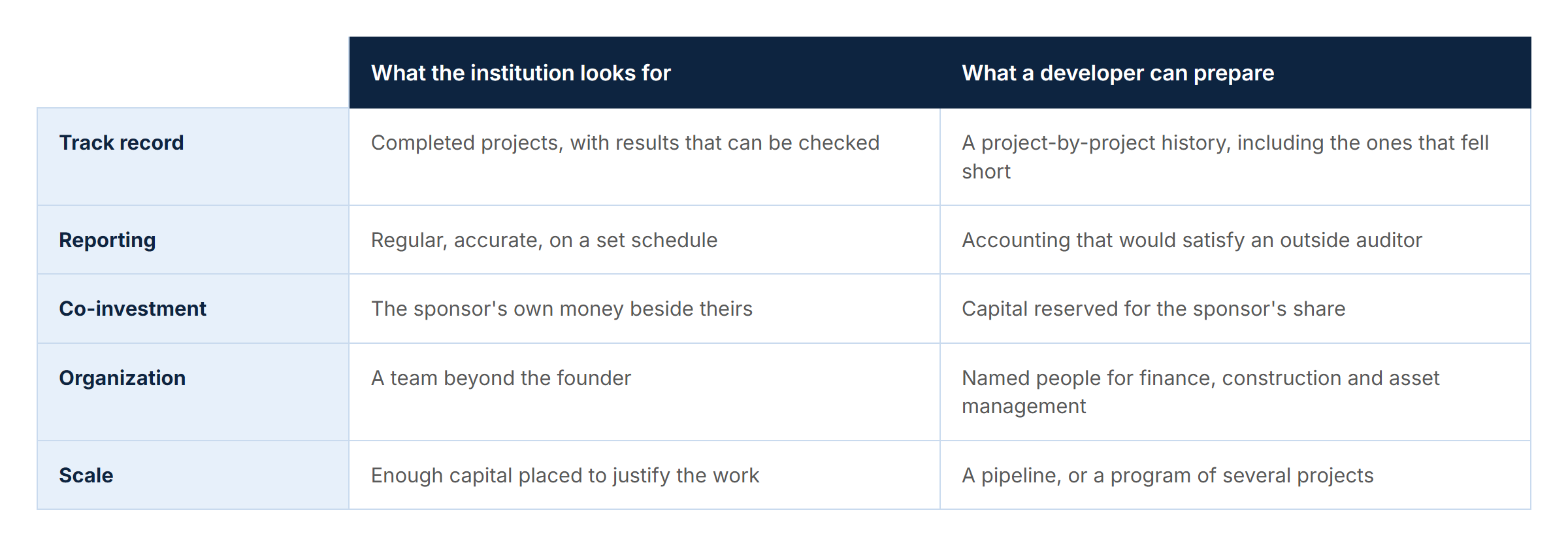
The first question is what the developer has done before. Institutions want completed projects of a similar kind, with results that can be checked: what was planned, what was spent, how long it took and what the investors received.
They ask about the projects that fell short as well. How a developer handled a difficult project tells them more than a list of successes.
A record built under another firm’s name counts for less unless the developer’s own role in it can be shown.
Reporting
Institutions require regular reports in a consistent form: financial statements, progress against budget and schedule, leasing and the outlook.
Many private developers have never had to report this way. Their investors were satisfied with a call and a year-end summary.
Building the accounting and reporting before the institution asks is one of the clearest signs that a developer is ready.
An institution invests in the project. It approves the developer.
Money beside theirs
Institutions expect the developer to invest in the project too. The amount matters less than its weight to the developer. It should be enough that a loss would be felt.
They also look at how the developer is paid. Fees that reward the developer whether or not the project succeeds raise questions. A structure that pays the developer most when the investors do well answers them.
An organization, not one person
A firm that depends entirely on its founder is a risk to an institution. It will ask who manages construction, who handles the finances and who looks after the property once it is built.
It will also ask what happens if the founder cannot work. Named people in defined roles, with some history together, answer that question.
Scale
Institutions have a minimum amount they can usefully invest. The work of approving and monitoring an investment is much the same whatever its size, so a small project may not be worth the effort for them.
A developer whose projects are too small for a direct investment has other routes. One is a program: an agreement to invest in several projects that meet agreed criteria. Another is a partner that sits between the developer and the institution, taking institutional capital and placing it with smaller sponsors.
What changes afterward
Institutional capital brings scale and repeat funding. It also brings consent rights, reporting duties and less room to change the plan alone.
Developers who make the change well tend to treat the institution’s requirements as the standard for the whole firm, not as a burden attached to one project.
The requirements of the first institutional partner become the operating standard of the firm.
Your next step
Write a project-by-project history of everything the firm has completed: plan against result, cost, time and returns to investors. Include the ones that fell short. If that record cannot be assembled from the firm’s own files, that is the first thing to fix.
This piece completes the series on real estate capital and transactions.
This article is general information. It is not investment, legal or tax advice, and it is not an offer to buy or sell any security.
Securities are offered through GT Securities, Inc. | Member FINRA, SIPC