Most real estate projects need more equity than the sponsor has. The usual answer is a partner.
A partner brings capital. It also brings rights. The agreement between the two decides how the profit is divided, who makes the decisions and what happens when the project does not go to plan.
Sponsors tend to negotiate the first of these hardest. The other two matter more when something goes wrong.
Two common arrangements
In a joint venture, a sponsor and a capital partner own the project together. The sponsor finds the property, arranges the financing and carries out the plan. The capital partner supplies most of the equity.
In a co-GP structure, two parties share the sponsor’s role itself. One may bring the property and local knowledge. The other may bring a balance sheet, a lender relationship or part of the sponsor’s equity. They share the sponsor’s fees and its share of the profit, and together they answer to the investors.
The two are often combined. A co-GP pair may form the sponsor side of a joint venture with an institutional investor.
How the profit is divided
Cash is distributed in an agreed order, often called the waterfall.
Investors usually receive their capital back first, with a stated return on it, called the preferred return. Above that level, the sponsor receives a share of the profit larger than its share of the capital. That larger share is the promote.
The promote is the sponsor’s reward for finding the project and making it perform. It may rise in steps as the return to investors rises.
Two details deserve attention. The first is the measure: whether the thresholds are tested on the whole investment or year by year. The second is whether the sponsor must return promote already received if later results fall short.
Who decides
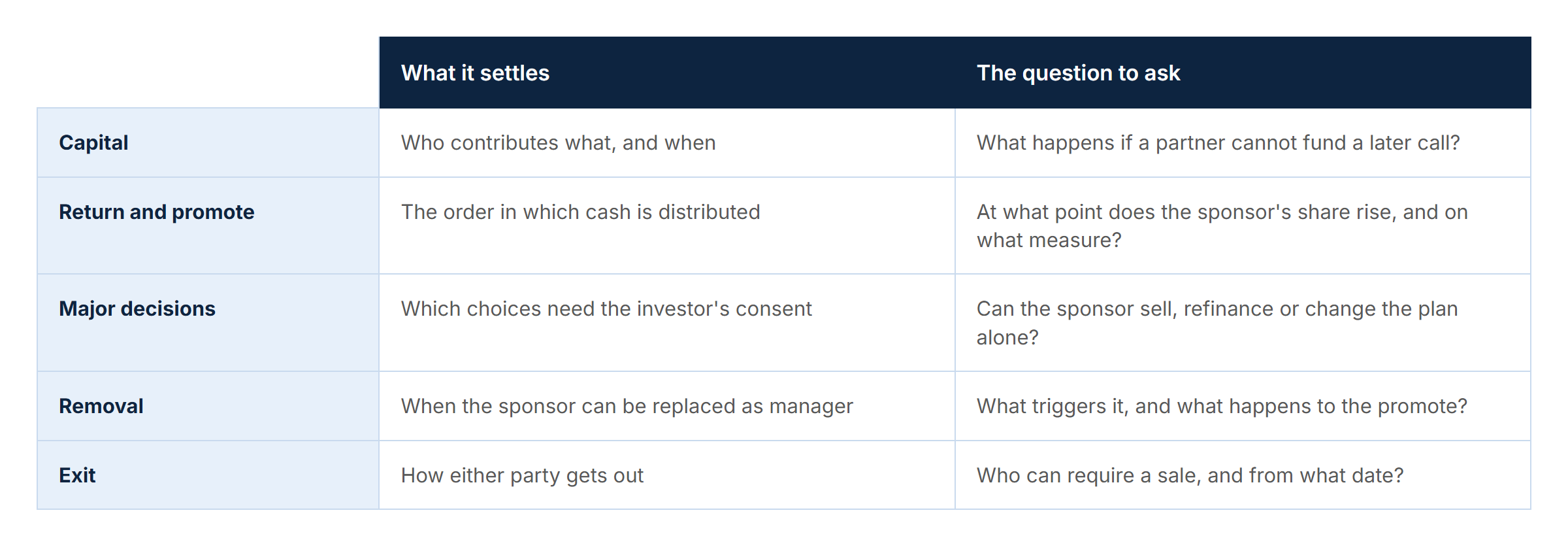
The sponsor manages the project day to day. The capital partner almost always holds consent rights over a list of major decisions.
That list commonly includes a sale, a refinancing, the annual budget, a material change to the business plan and any transaction with an affiliate of the sponsor.
A short list leaves the sponsor free to act. A long one means the sponsor manages the project while the investor steers it. Neither is wrong, and each party should know which one it is signing.
A sponsor shares the profit by percentage. It shares control by the list of decisions that need consent.
When more capital is needed
Projects run over budget, and loans sometimes need to be paid down. The agreement says what happens when the venture needs more money.
If one partner cannot fund its share, the other may be allowed to fund it instead. The terms of that funding vary. It may be treated as a loan at a high rate, or it may reduce the ownership of the partner that did not fund, sometimes by more than the amount involved.
A sponsor with limited cash should read these terms as carefully as the promote.
Removal and exit
The capital partner can usually remove the sponsor as manager for cause. The definition of cause is negotiated: fraud and misuse of funds at one end, missed performance tests at the other.
What happens to the sponsor’s promote and fees after removal is a separate question, and the answer differs from agreement to agreement.
Exit terms matter as much. One party may have the right to require a sale after a set date. A buy-sell clause lets one partner name a price at which the other must either buy or sell. That favors the partner with more cash on hand.
Between two sponsors
In a co-GP arrangement, the same questions arise between the two sponsors. Who signs the loan guaranties, and is that party compensated for it? Who speaks to the investors and the lender? How are fees divided if one party does more of the work than expected?
These are easier to settle before the property is under contract than after.
The agreement is written for the day the partners disagree. On every other day, nobody opens it.
Your next step
Take one joint venture agreement you have signed or been offered. Find three things: the list of major decisions, the terms for a partner that cannot fund a capital call and the definition of cause for removal. If any of the three is a surprise, raise it with counsel before the next agreement.
The next piece in this series covers the business that owns its own building, and whether to sell the two together or apart.
This article is general information. It is not investment, legal or tax advice, and it is not an offer to buy or sell any security.
Securities are offered through GT Securities, Inc. | Member FINRA, SIPC