
A building has one address and several owners of its risk.
A sponsor tends to describe a project by its total cost. The lender, the mezzanine lender and the equity partner each see a different project, because each stands in a different place in line.
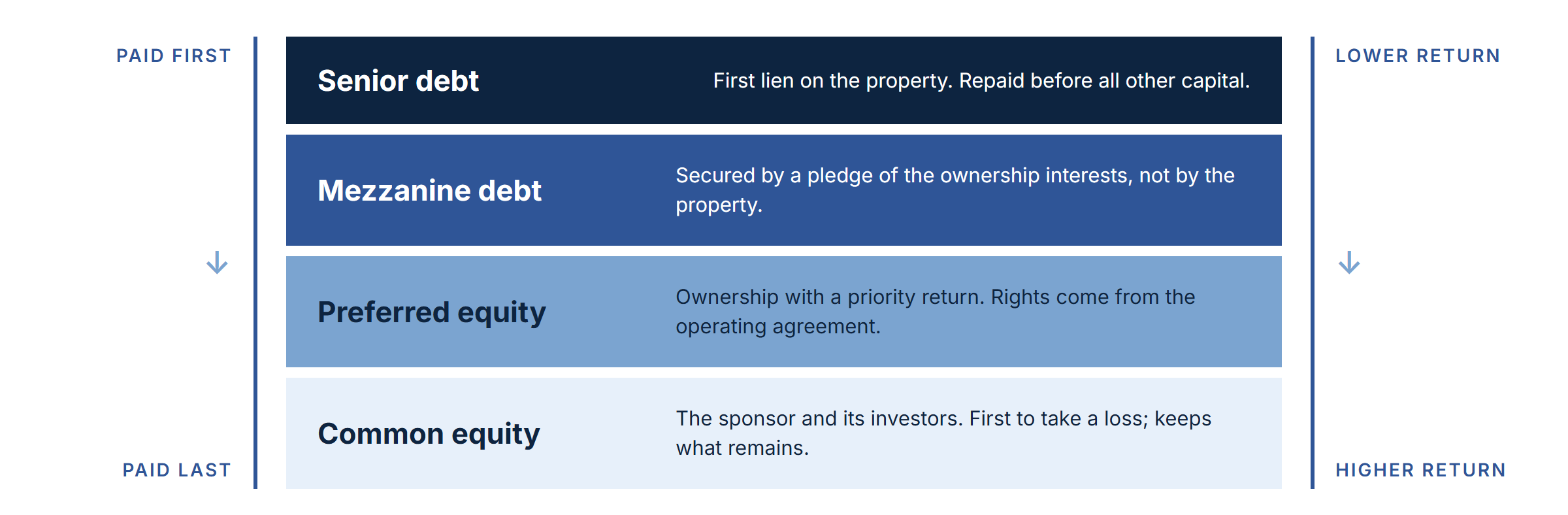
That line is the capital stack. It sets the order in which the parties are repaid, from the income of the property and from its sale.
When a project performs, the order is hardly noticed. When it does not, the order decides nearly everything.
Senior debt: first in line, lowest return
The senior loan is the mortgage. It is secured by a first lien on the property and is repaid before any other capital.
Because it is first, it is the least expensive layer. The lender accepts a lower return in exchange for the strongest protection: the right to take the property itself if the loan is not paid.
Senior lenders underwrite the downside. Their question is not how well the project could do. It is what the property is worth, and what income it produces, if the plan falls short.
Mezzanine debt: filling the gap
Mezzanine debt sits between the senior loan and the equity. It is repaid after the senior lender and before the owners.
It is usually secured by a pledge of the ownership interests in the company that owns the property, not by the property. If the loan defaults, the mezzanine lender’s remedy is to take over that company, and with it the building and the senior loan.
The standing of the two lenders toward each other is set out in an intercreditor agreement. It is one of the most important documents in the stack, and the borrower is often not a party to it.
Preferred equity: ownership with priority
Preferred equity is an ownership interest, not a loan. It has no lien. Its holder is paid a set return ahead of the common equity, and its rights come from the operating agreement.
Those rights can be substantial. If the preferred return is not paid, the holder may be able to remove the sponsor from control.
Preferred equity and mezzanine debt can look alike in a model. They differ in their remedies, in how a senior lender treats them and in their tax and accounting treatment. The choice between them is a question for counsel as much as for the spreadsheet.
Return follows position. The further back in line, the more the capital must be paid to stand there.
Common equity: last in line, first to lose
Common equity belongs to the sponsor and its investors. It is paid last and receives whatever remains. That means the first dollar of loss and all of the gain left after the other layers are paid.
Common equity usually has its own internal order. Investors typically receive their capital back and a stated return before the sponsor shares more heavily in the profit. How that is divided is the subject of the next piece in this series.
Why the order matters most when plans change
Three moments test a capital stack:
- Income falls short. Cash pays the senior loan first. The lower layers may go unpaid, and their remedies begin to apply.
- A loan matures and cannot be refinanced in full. If values have fallen, a new senior loan may not repay the old one. Someone must contribute new capital or give up position.
- A sale comes in below expectations. Proceeds flow down the stack in order and stop where they run out.
In each case, the party with the right to act is not always the party with the most money invested. Those rights are set in the loan agreement, the intercreditor agreement and the operating agreement, on the day the financing closes.
Control in a downturn is written into the documents long before the downturn arrives.
Cost is not the only measure
It is natural to compare the layers by rate. More debt, and more layers of it, can lower the blended cost of capital and raise the projected return on equity.
Each added layer also adds a party with rights. That can mean fewer options later: a sale, a refinancing or a change of business plan may each require a consent.
Two questions belong beside the rate. Who can take control, and under what conditions? Who must agree before the plan can change?
Your next step
Draw the stack for one property or project you own. For each layer, write the amount, what secures it and what its holder may do if it is not paid. If the last column cannot be filled in from memory, read the documents before the next financing.
The next piece in this series covers joint ventures and co-GP structures, and how the common equity is divided.
This article is general information. It is not investment, legal or tax advice, and it is not an offer to buy or sell any security.
Securities are offered through GT Securities, Inc. | Member FINRA, SIPC