A company that owns its building has capital in the walls.
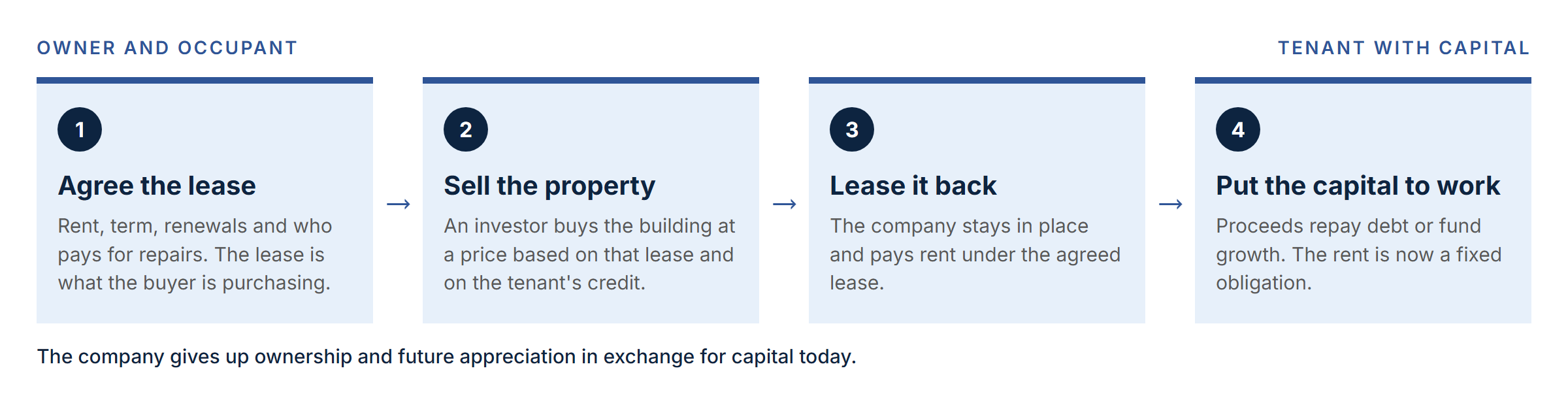
A sale-leaseback releases it. The company sells the property to an investor and, at the same closing, signs a long lease to stay in it. Operations do not move. The company stops being an owner and becomes a tenant.
It is a way of raising capital without borrowing and without selling shares. It is also a long commitment, and the terms are set once.
How it works
There are two agreements, negotiated together: a sale of the property and a lease back to the seller.
The lease is usually long, and it is commonly a net lease, under which the tenant continues to pay the taxes, insurance and upkeep. From the investor’s side, it is buying a stream of rent backed by the company’s credit.
The price of the building and the rent are therefore linked. The investor sets its price from the rent it will receive and from its view of the tenant.
Why companies use it
A sale-leaseback suits a company that can earn more by putting capital into its business than by leaving it in property.
The proceeds are commonly used to repay debt, fund growth or an acquisition, or buy out a partner. The transaction is also used alongside the sale of a company, where the buyer of the business does not want to own the real estate.
A sale releases the full value of the property. A mortgage releases only part of it. In exchange, the company gives up ownership.
Who buys
The buyers are investors who want long, steady income: net lease funds, real estate investment trusts, insurance companies, private investors and family offices.
They underwrite two things. The first is the tenant: its financial strength and its ability to pay rent across the whole term. The second is the building: how essential it is to the tenant’s operations, and how easily it could be let to someone else if the tenant left.
A strong tenant in a building it cannot easily leave is the profile these buyers seek.
In a sale-leaseback, the investor is buying the lease. The building is what secures it.
What the lease must settle
The lease will govern the property for many years. Five terms carry most of the weight:
- Rent and increases. The starting rent and how it rises over the term.
- Term and renewals. How long the company is committed, and its options to extend.
- Repairs and capital costs. Who pays for the roof, the structure and major systems.
- Flexibility. Whether the company may sublet, assign the lease to a buyer of the business, alter the building or expand.
- The end of the term. What condition the building must be returned in, and whether the company has any right to buy it back.
Flexibility is the one most often overlooked. A lease that cannot be assigned can complicate a later sale of the company.
What the company gives up
The company gives up the property’s future appreciation. It gives up the freedom to do as it likes with the building. It takes on rent as a fixed cost that continues in weak years as well as good ones.
A rent set too high in order to raise the sale price is a burden the business carries for the length of the lease. The best price on the day of sale is not always the best transaction.
There are tax and accounting consequences as well. They depend on the company’s own facts and should be reviewed with its advisors before terms are agreed.
The proceeds arrive once. The rent is paid every month for the life of the lease.
When it fits, and when it does not
A sale-leaseback fits a company that will need the building for the long term, has a productive use for the capital and can carry the rent comfortably.
It fits less well when the company may outgrow or leave the site within a few years, or when the building is so specialized that few investors would want it.
Your next step
Before seeking offers, answer three questions. How long will the business need this building? What will the capital be used for, and what will it earn there? What rent can the business carry in a poor year? The answers set the terms worth accepting.
The next piece in this series covers commercial lending, and what lenders underwrite now.
This article is general information. It is not investment, legal or tax advice, and it is not an offer to buy or sell any security.
Securities are offered through GT Securities, Inc. | Member FINRA, SIPC