
A company needs capital. More debt would strain it, and the owners do not want to sell a large share of the business at today’s value.
Preferred equity sits between the two. The investor becomes an owner, with no fixed repayment date in the way a loan has one. In return, the investor is paid before the common shareholders and holds rights they do not.
It is flexible, and the same name covers very different arrangements. The terms decide what it is.
How it differs from a loan
A lender is owed interest and principal on set dates, and can enforce if they are not paid. A preferred investor generally cannot. A missed preferred return usually accumulates and is paid later.
That gives the company room in a difficult year. It is the main reason preferred equity is used where more debt would be imprudent.
The room has a price. Preferred equity usually costs more than debt, and its holder’s rights grow when the company falls short.
How it differs from common equity
Common shareholders own what is left after everyone else is paid. Preferred holders are paid ahead of them, up to an agreed amount.
In a strong outcome, that priority may not matter. In a modest one, it can take most of what is available.
Whether the preferred holder also shares in the upside depends on the terms.
Preferred equity is defined by its terms. The name tells the owner very little.
Five terms that decide what it is
The return. A stated rate on the amount invested. It may be paid in cash, or added to the amount owed. A return that accrues is easier on cash flow and grows the claim ahead of the common shareholders.
The priority. On a sale, the preferred holder receives its investment and unpaid return first. Some terms entitle it to a multiple of its investment.
Conversion and participation. The holder may have the right to convert into common shares and share in the upside in place of its priority. Under some terms, it receives its priority and a share of the remainder too.
Redemption. The company may be required to buy the preferred back on a set date, or the holder may have the right to demand it. A redemption date the company cannot meet works much like a loan falling due.
Consent rights. The holder usually must approve major decisions: new debt, new shares, a sale, a change of business. These rights commonly expand if the return goes unpaid or a redemption is missed.
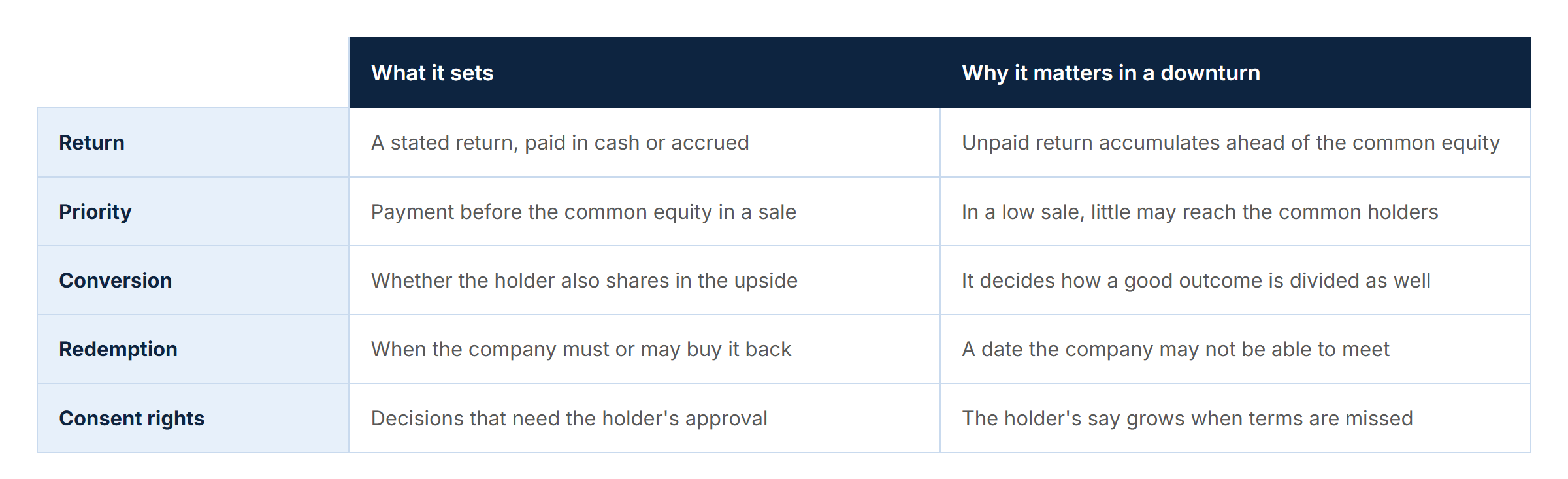
In a downturn
Preferred equity is easiest to live with when the company performs. The terms are tested when it does not.
An unpaid return grows. The priority claims more of a reduced value. Consent rights widen, and in some agreements the holder gains the right to appoint directors or to require a sale.
Owners should read the terms with a poor year in mind, not the plan.
In a good year, preferred equity is a quiet partner. The terms describe what it becomes in a bad one.
When it fits
Preferred equity suits a company with a clear use for the capital and a reason not to borrow more: lenders at their limit, uneven cash flow or a period of investment ahead of earnings.
It also suits owners who believe the company will be worth much more later and prefer to pay a fixed return now over giving up a large share of ownership.
It fits less well when the company’s prospects are uncertain and a fixed, accumulating claim could come to rank ahead of most of its value.
Your next step
For any preferred equity proposal, work out what the common shareholders would receive in three cases: a sale at the plan’s value, at half of it and at the amount of the debt plus the preferred. The third case shows what the terms mean.
The next piece in this series covers bridge financing, capital for the months in between.
This article is general information. It is not investment, legal or tax advice, and it is not an offer to buy or sell any security.
Securities are offered through GT Securities, Inc. | Member FINRA, SIPC