
A sale gets its best result when several qualified buyers compete. It gets its worst when the market learns the company is for sale before the owner is ready.
These two facts pull against each other. More buyers means more competition, and more people who know.
A well-run process resolves the tension by controlling three things: who is approached, what each is told and when.
Building the buyer list
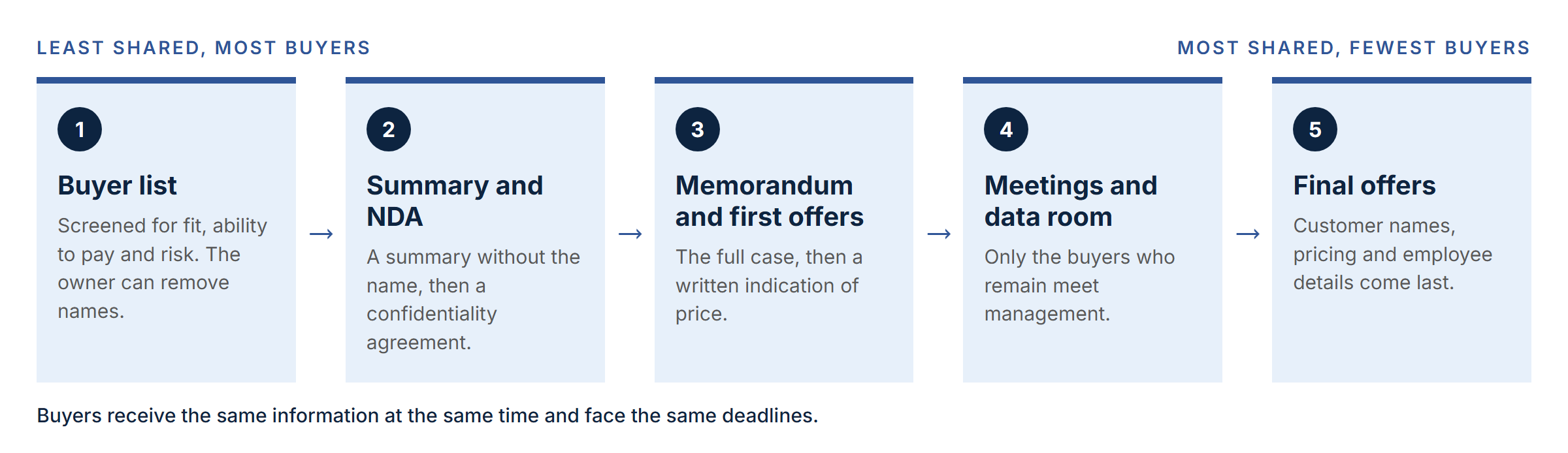
The list is screened for fit, for the ability to pay and for risk. The owner reviews it and can remove names: a competitor who should never see the business, or a customer whose reaction is uncertain.
There are three broad ways to run a sale:
- A broad process. Many buyers are approached. Competition is highest and confidentiality is lowest.
- A targeted process. A limited group of well-matched buyers is approached. For many middle-market companies this is the workable balance.
- A negotiation with one buyer. It is the most confidential and gives the seller the least competitive pressure.
The choice follows from how much a leak would cost the business.
Staged disclosure
Information is released in stages, and each stage asks more commitment of the buyer.
A summary without the company’s name comes first. A confidentiality agreement follows, then the full memorandum, then a written indication of price. Only buyers who remain are invited to meet management and enter the data room.
The most sensitive items come last: customer names, pricing and employee details. Sometimes they are shared only with a small group on the buyer’s side.
The confidentiality agreement in a sale
In a sale, the agreement usually goes beyond secrecy. It bars contact with employees, customers and suppliers without permission, and it restricts hiring the company’s people for a period. Terms for competitors are tighter.
Enforcing such an agreement after a breach is slow and uncertain. The practical protection is not sending what does not need to be sent.
The practical protection is not sending what does not need to be sent.
Keeping the schedule
Competition depends on timing. Buyers receive the same information at the same time and face the same deadlines for their offers.
If one buyer is allowed to move ahead alone, the pressure on all of them eases. A buyer that asks for exclusivity early is asking the seller to give up competition, and that request has a price.
Competition comes from the schedule as much as from the number of buyers.
Employees
Inside the company, a small group needs to know, usually the chief financial officer and one or two others. They will carry extra work for months, and it is worth planning how they are kept and rewarded.
Buyer visits are arranged discreetly. The wider team is usually told at signing or closing, with a clear account of what it means for them.
Customers and suppliers
Buyers will want to speak with the most important customers before they close. Those conversations come late, after the main terms are agreed, and the seller decides how they are introduced.
An early leak to a customer is a gift to competitors, who will use it.
If word gets out
Leaks happen in the best-run processes. Decide in advance who responds and what they say.
A brief, calm and consistent answer does less harm than silence. A denial that later proves untrue does the most harm of all.
Your next step
List the three pieces of information that would do the most damage in a competitor’s hands. For each, decide at what stage it would be released and to whom. That list sets the confidentiality terms the process needs.
The next piece in this series covers the letter of intent, and the terms in it that matter more than the headline price.
This article is general information. It is not investment, legal or tax advice, and it is not an offer to buy or sell any security.
Securities are offered through GT Securities, Inc. | Member FINRA, SIPC