
Two software companies report the same revenue. One is valued at several times the other.
The difference is usually the kind of revenue. A buyer pays more for revenue it can expect to receive again next year without having to win it again.
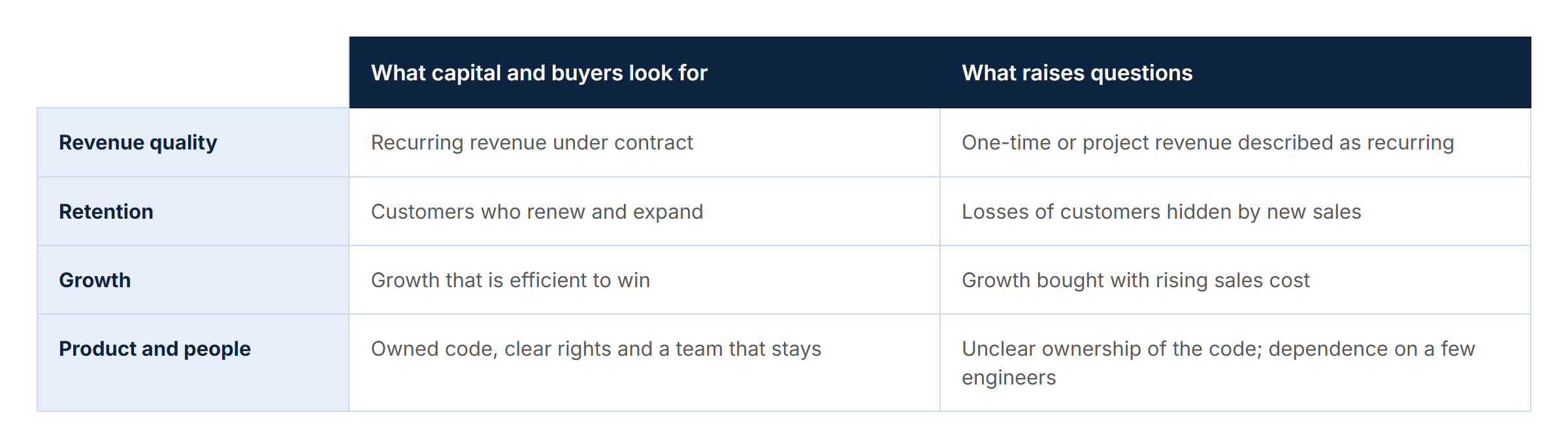
Recurring revenue is the center of how technology companies are valued. Because so much depends on it, buyers and investors examine it closely. Four questions guide them.
Is the revenue truly recurring?
Recurring revenue is paid under a continuing arrangement, such as a subscription or a contract that renews. It differs from revenue earned once: an implementation, a custom project or a one-time license.
Companies sometimes describe revenue as recurring when it only tends to repeat. A buyer will separate the two.
It will read the contracts. It will ask about their length, their renewal terms and whether customers can leave early. It will set usage-based and project revenue apart from subscriptions.
A company that reports the categories clearly, and consistently over time, saves the buyer the work and gains its confidence.
Do customers stay?
Recurring revenue is worth only as much as the customers’ habit of renewing.
Buyers measure retention in two ways. One counts how many customers remain. The other counts how much revenue remains from last year’s customers, including what they have added.
A company whose existing customers spend more each year can grow before it wins a single new one. A company that must replace a large share of its revenue each year is running to stand still.
Buyers also look at who leaves and why, and whether a few large customers account for much of the total.
New sales show that a product can be sold. Renewals show that it works.
Is growth efficient?
Growth is valued. Growth that costs more than it returns is not.
Buyers ask what the company spends to win a customer and how long that customer takes to repay the cost. They compare growth with the losses incurred to achieve it.
The weight placed on growth against profit shifts with market conditions. A company that can show both, or a clear path from one to the other, is on firm ground in any market.
Who owns the product, and who builds it?
A technology company’s main assets are its code and its people.
Buyers confirm that the company owns its software. They review agreements with employees and contractors who wrote it, and they check how open-source components have been used. Gaps here are common in companies that grew quickly, and they can usually be corrected if found early.
They look at security and data protection, which carry legal and reputational risk.
They also ask who the product depends on. If a few engineers hold the knowledge of how it works, their staying matters to the deal.
Who invests and who buys
Strategic buyers acquire technology to add products, customers or talent, and may pay for what the company is worth inside their own business.
Private equity firms buy software companies with steady recurring revenue, often to combine them with others. Growth investors fund expansion in exchange for a minority share. Lenders now provide debt against recurring revenue as well as against earnings.
Each reads the same figures with a different aim. A strategic buyer weighs fit. A financial buyer weighs retention and cash flow.
Preparing
A company preparing for a raise or a sale should be able to produce three things without delay: revenue by type and by customer over several years, retention measured both ways, and a clean record of who wrote the code and under what agreement.
The figure a buyer pays for is not this year’s revenue. It is the part of it that will come back.
Your next step
Take last year’s customers and total what the same customers paid this year. Compare the two figures. If the second is higher, the company has a strong story to tell. If it is lower, find out which customers left and why before a buyer asks.
This piece completes the series on capital and buyers by sector.
This article is general information. It is not investment, legal or tax advice, and it is not an offer to buy or sell any security.
Securities are offered through GT Securities, Inc. | Member FINRA, SIPC