
A borrower sees a property and a plan. A lender sees a loan that has to be repaid if the plan does not work.
That difference explains most of what happens in a loan application. The lender is not asking how well the property could do. It is asking what happens to its money if things go less well than expected.
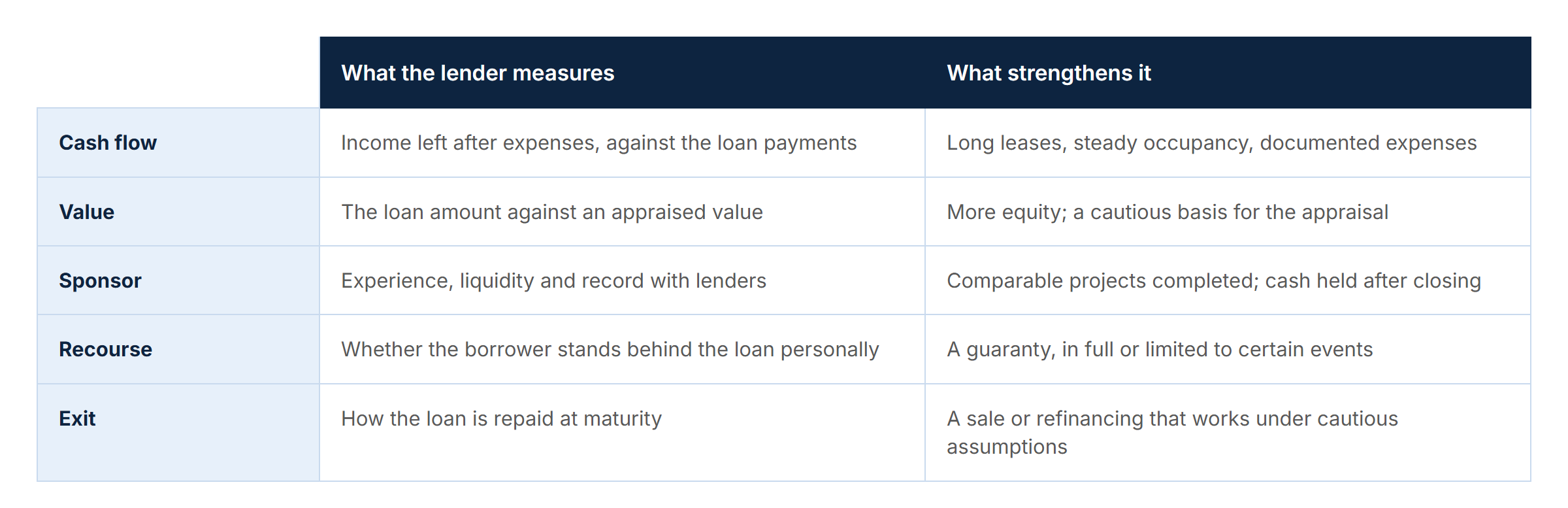
Five tests carry most of the decision.
Cash flow
The first test is whether the property’s income covers the loan payments, with room to spare.
Lenders measure the income left after operating expenses against the payments due each year. The margin they require rises with the risk they see in the income.
They also look at where the income comes from. Long leases to strong tenants count for more than short leases or a single tenant. Lenders often apply their own assumptions for vacancy and expenses, whatever the property’s recent results.
Value
The second test is the size of the loan against the value of the property.
The value is the lender’s, set by an appraiser the lender chooses. It may be lower than the price the borrower paid or the figure in the borrower’s plan.
The more equity the borrower has in the property, the more protection the lender has, and the better the terms tend to be.
The sponsor
The third test is the borrower. Lenders ask whether the sponsor has done this before, with this kind of property, in this market.
They look at liquidity: the cash the sponsor will still hold after closing. They look at net worth. They also look at the sponsor’s record with other lenders, including how past difficulties were handled.
A sponsor who met a problem openly and resolved it is often viewed better than one whose history cannot be checked.
A lender underwrites the property, the borrower and the way out. A weakness in one has to be made up in the others.
Recourse
The fourth test is what stands behind the loan beyond the property.
Under a recourse loan, the sponsor guarantees repayment personally. Under a non-recourse loan, the lender looks only to the property, with exceptions for certain acts by the borrower, such as fraud or misuse of funds.
Many loans sit between the two. A guaranty may cover part of the loan, or fall away once the property reaches a stated level of performance. Guaranties of completion are common in construction lending.
Recourse is negotiated. A sponsor should know exactly what they are guaranteeing and when the guaranty ends.
The way out
The fifth test is how the loan is repaid at maturity. Most commercial real estate loans are not paid off from income. They are repaid by a sale or by a new loan.
The lender therefore tests whether the property could be refinanced or sold at maturity under cautious assumptions. A loan that works today and cannot be refinanced later is a problem the lender prefers not to create.
Different lenders, different weights
All lenders apply these tests. They weigh them differently.
- Banks value the relationship and the sponsor, often want deposits and commonly ask for recourse.
- Life insurance companies favor stable, well-leased properties and lend at lower leverage for longer terms.
- Agency and securitized lenders work to set programs and are often non-recourse.
- Debt funds and private lenders accept properties in transition, lend more against value and charge more for it.
The same property can be a poor fit for one and a good fit for another. Matching the loan to the lender is much of the work.
Preparing the request
A complete, accurate package shortens the process: the rent roll, operating statements, the business plan, the sponsor’s financial statement and its record of comparable projects.
Weaknesses belong in the package, with an explanation. A lender that finds a problem on its own will wonder what else is missing.
The borrower presents the plan. The lender prices what happens if the plan falls short.
Your next step
Before approaching a lender, write a one-page answer to each of the five tests for the property in question. Where an answer is weak, decide what makes up for it: more equity, a guaranty, a longer lease or a different kind of lender.
The next piece in this series covers institutional capital, and what it takes for a private developer to qualify.
This article is general information. It is not investment, legal or tax advice, and it is not an offer to buy or sell any security.
Securities are offered through GT Securities, Inc. | Member FINRA, SIPC